Options
Effect of liposome encapsulation of tea catechins on their accumulation in basal cell carcinomas
Type
article
Resource
J Dermatol. Sci.(42):101-109.
Date Issued
2006
Author(s)
Fang JY; Lee WR; Shen SC; Huang YL
Subjects
臨床醫學研究所
期刊論文
Abstract
Summary
Background
(−)-Epigallocatechin gallate (EGCG), the main active polyphenol in green tea, is associated with antioxidant and anticancer activities.
Objective
The aim of this study was to evaluate the feasibility of using liposomes for intratumor distribution of EGCG and its derivative, (+)-catechin.
Method
Liposomes containing egg phosphatidylcholine, cholesterol, or anionic surfactant in the presence of 15% ethanol were prepared. The physicochemical characteristics including vesicle size, zeta potential, drug entrapment, and drug release of liposomal formulations were determined. The liposomes containing EGCG were injected into basal cell carcinomas (BCCs), melanomas, and colon tumors to examine the tumor uptake of the drug. Liposomes were also incubated with a given number of BCC cells, and the cell viability was estimated.
Result
Almost no drug molecules were observed when free EGCG was administered to BCCs. EGCG encapsulated in liposomes with deoxycholic acid (DA) and ethanol increased drug deposition by 20-fold as compared to the free form. The larger vesicle size of this formulation was suggested to be the predominant factor governing this enhancement. The liposomes without ethanol showed low or negligible enhancement on EGCG uptake in BCCs. Liposomes protected EGCG from degradation, resulting in the induction of greater BCC death compared to that by free EGCG at lower concentrations.
Conclusion
These results suggest that the intratumor injection of liposomes containing EGCG with moderate modification is an effective approach for increasing EGCG deposition in BCCs.
Keywords: (−)-Epigallocatechin gallate; Liposomes; Intratumor; Basal cell carcinoma
Background
(−)-Epigallocatechin gallate (EGCG), the main active polyphenol in green tea, is associated with antioxidant and anticancer activities.
Objective
The aim of this study was to evaluate the feasibility of using liposomes for intratumor distribution of EGCG and its derivative, (+)-catechin.
Method
Liposomes containing egg phosphatidylcholine, cholesterol, or anionic surfactant in the presence of 15% ethanol were prepared. The physicochemical characteristics including vesicle size, zeta potential, drug entrapment, and drug release of liposomal formulations were determined. The liposomes containing EGCG were injected into basal cell carcinomas (BCCs), melanomas, and colon tumors to examine the tumor uptake of the drug. Liposomes were also incubated with a given number of BCC cells, and the cell viability was estimated.
Result
Almost no drug molecules were observed when free EGCG was administered to BCCs. EGCG encapsulated in liposomes with deoxycholic acid (DA) and ethanol increased drug deposition by 20-fold as compared to the free form. The larger vesicle size of this formulation was suggested to be the predominant factor governing this enhancement. The liposomes without ethanol showed low or negligible enhancement on EGCG uptake in BCCs. Liposomes protected EGCG from degradation, resulting in the induction of greater BCC death compared to that by free EGCG at lower concentrations.
Conclusion
These results suggest that the intratumor injection of liposomes containing EGCG with moderate modification is an effective approach for increasing EGCG deposition in BCCs.
Keywords: (−)-Epigallocatechin gallate; Liposomes; Intratumor; Basal cell carcinoma
File(s)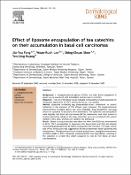
Loading...
Name
attachment.pdf
Size
389.41 KB
Format
Adobe PDF
Checksum
(MD5):0afe777f8e51f8179c4a3b25a7309148
Loading...
Name
attachment2.pdf
Size
35.91 KB
Format
Adobe PDF
Checksum
(MD5):eba6f88c6a0fc1c2488d591e6268faa2