Options
Induction of TIMP-1 and HSP47 synthesis in primary keloid fibroblasts by exogenous nitric oxide
Type
article
Resource
Journal of Dermatological Science.(45):37-44.
Date Issued
2007
Author(s)
汪棱芳
Hsu YC; Wang LF; Chien YW; Lee WR
Subjects
學科:生物化學暨細胞分子生物學科
期刊論文
Abstract
Background
The excessive accumulation of extracellular matrix is a hallmark of many fibrotic diseases, including the hypertrophic scar and keloid. Recent reports from this research team had shown that exogenous nitric oxide (NO) participates in the keloid formation; however, its role on the synthesis of fibrotic factor (TGF-β1, TIMP-1 and HSP47) in the keloid fibroblasts (KF) remained unclear.
Objective
In this study, to better define the potential effect of exogenous NO on the expression of fibrotic factors in KF, the enhancing effect of exogenous NO, released from a NO donor, on the synthesis of fibrotic factors in KF was investigated.
Methods
The seven primary KF cultures were set up to measure the effect of exogenous NO on enhancing the expression of fibrotic factor.
Results
Elevation of cellular cGMP levels was observed to be induced by NO or blocked by the hydrolysis activity of phosphodiesterase (PDE) by the PDE inhibitor. The elevated levels of cellular cGMP were noted to enhance the expression of TIMP-1 and HSP47 in KF. Exogenous NO was found to significantly accelerate the production of TIMP-1 and HSP47 in the seven primary KFs with a corresponding increase in the production of TGF-β1.
Conclusion
The results have led to a conclusion, that is: the excess collagen formations in the keloid lesion may be attributed to the NO/cGMP signal pathway by initiating a rapid increase in the expression of TGF-β1, TIMP-1 and HSP47 in the KF cells.
Keywords: Nitric oxide (NO); Heat shock protein 47 (HSP47); Tissue inhibitor of MMP (TIMP)-1
Article Outline
The excessive accumulation of extracellular matrix is a hallmark of many fibrotic diseases, including the hypertrophic scar and keloid. Recent reports from this research team had shown that exogenous nitric oxide (NO) participates in the keloid formation; however, its role on the synthesis of fibrotic factor (TGF-β1, TIMP-1 and HSP47) in the keloid fibroblasts (KF) remained unclear.
Objective
In this study, to better define the potential effect of exogenous NO on the expression of fibrotic factors in KF, the enhancing effect of exogenous NO, released from a NO donor, on the synthesis of fibrotic factors in KF was investigated.
Methods
The seven primary KF cultures were set up to measure the effect of exogenous NO on enhancing the expression of fibrotic factor.
Results
Elevation of cellular cGMP levels was observed to be induced by NO or blocked by the hydrolysis activity of phosphodiesterase (PDE) by the PDE inhibitor. The elevated levels of cellular cGMP were noted to enhance the expression of TIMP-1 and HSP47 in KF. Exogenous NO was found to significantly accelerate the production of TIMP-1 and HSP47 in the seven primary KFs with a corresponding increase in the production of TGF-β1.
Conclusion
The results have led to a conclusion, that is: the excess collagen formations in the keloid lesion may be attributed to the NO/cGMP signal pathway by initiating a rapid increase in the expression of TGF-β1, TIMP-1 and HSP47 in the KF cells.
Keywords: Nitric oxide (NO); Heat shock protein 47 (HSP47); Tissue inhibitor of MMP (TIMP)-1
Article Outline
File(s)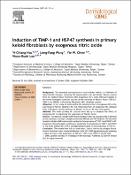
Loading...
Name
attachment.pdf
Size
343.29 KB
Format
Adobe PDF
Checksum
(MD5):198e4b66639e13bbd0d36d394ae4769e
Loading...
Name
attachment2.pdf
Size
36.68 KB
Format
Adobe PDF
Checksum
(MD5):31b77ea5bea426b02301b89f138c5a4d