Options
Consumption of Purple sweet potato leaves modulates human immune response: T-lymphocyte functions, lytic activity of natural killer cell and antibody production
Type
article
Resource
Gastroenterology.(11):5751-5914
Date Issued
2005
Author(s)
Chen CM
Li SC
Lin YL
Hsu CY
Shieh MJ
Liu JF
Subjects
保健營養學系
期刊論文
Abstract
AIM: To study the immunological effects of physiological doses of purple sweet potato leaves (PSPL).
METHODS: The randomized crossover study (two periods, each lasting for 2 wk) involved 16 healthy non-smoking adults of normal weight. The 6-wk study consisted of a run-in (wk 1) PSPL diet (daily consumption of 200 g (PSPL) or a control diet (low polyphenols, with the amount of carotenoids adjusted to the same level as that of (PSPL) (wk 2-3), washout diet (wk 4), and switched diet(wk 5-6). Fasting blood was collected weekly in the
morning. T-lymphocyte function was assessed via the proliferation and secretion of immunoreactive cytokines. Salivary IgA secretion and the specific cytotoxic activities of cytotoxic T lymphocytes and natural killer (NK) cells were determined.
RESULTS: The plasma β-carotene level increased with time in both groups, while the plasma polyphenol level decreased in the control group, and no significant difference was detected between the two groups. Although plasma polyphenol levels did not significantly increase in the PSPL group at the end of the study, they were significantly elevated in urine. PSPL consumption produced a significant increase in proliferation responsiveness of peripheral blood mononuclear cells (PBMC) and their secretion of immunoreactive IL-2 and IL-4. As well, lytic activity in NK cells was elevated in a time-dependent fashion. Salivary IgA secretion significantly decreased in control group after 2 wk, and returned to baseline following dietary switch to PSPL.
CONCLUSION: Consumption of PSPL modulates
various immune functions including increased
proliferation responsiveness of PBMC, secretion of cytokines IL-2 and IL-4, and the lytic activity of NK cells. The responsible determinants of PSPL remain to be
elucidated, as does the biological significance of the present observations.
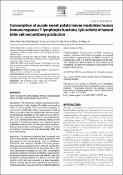
METHODS: The randomized crossover study (two periods, each lasting for 2 wk) involved 16 healthy non-smoking adults of normal weight. The 6-wk study consisted of a run-in (wk 1) PSPL diet (daily consumption of 200 g (PSPL) or a control diet (low polyphenols, with the amount of carotenoids adjusted to the same level as that of (PSPL) (wk 2-3), washout diet (wk 4), and switched diet(wk 5-6). Fasting blood was collected weekly in the
morning. T-lymphocyte function was assessed via the proliferation and secretion of immunoreactive cytokines. Salivary IgA secretion and the specific cytotoxic activities of cytotoxic T lymphocytes and natural killer (NK) cells were determined.
RESULTS: The plasma β-carotene level increased with time in both groups, while the plasma polyphenol level decreased in the control group, and no significant difference was detected between the two groups. Although plasma polyphenol levels did not significantly increase in the PSPL group at the end of the study, they were significantly elevated in urine. PSPL consumption produced a significant increase in proliferation responsiveness of peripheral blood mononuclear cells (PBMC) and their secretion of immunoreactive IL-2 and IL-4. As well, lytic activity in NK cells was elevated in a time-dependent fashion. Salivary IgA secretion significantly decreased in control group after 2 wk, and returned to baseline following dietary switch to PSPL.
CONCLUSION: Consumption of PSPL modulates
various immune functions including increased
proliferation responsiveness of PBMC, secretion of cytokines IL-2 and IL-4, and the lytic activity of NK cells. The responsible determinants of PSPL remain to be
elucidated, as does the biological significance of the present observations.
File(s)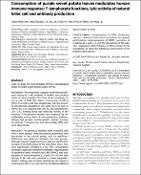
Loading...
Name
attachment.pdf
Size
331.22 KB
Format
Adobe PDF
Checksum
(MD5):6a0f452f79262b091016ae1b2b2b4d40
Loading...
Name
attachment2.pdf
Size
330.81 KB
Format
Adobe PDF
Checksum
(MD5):1ad6d72db1b7826e44caf0dc4fb01597