Options
Seasonal variations in serum sodium levels and other biochemical parameters among peritoneal dialysis patients.
Type
article
Resource
Nephrology Dialysis Transplantation.(23):687-692.
Date Issued
2008
Author(s)
陳振文
Li SY; Chen JY; Chuang CL; Chen TW
Subjects
內科學科
Abstract
Background. Although modest seasonal variations in blood biochemical composition have been reported in end-stage renal disease patients treated with haemodialysis, there have been no adequate explanations. The current study aimed to explore whether these phenomena are present in peritoneal dialysis patients and to discuss these variations.
Methods. This was a retrospective study with an enrollment of 44 anuric PD patients. Serum biochemical parameters, peritoneal function, dialysis adequacy, peritoneal ultrafiltration volume and body weight were analysed in relation to climate variables for a study period of 2 years.
Results. PD patients exhibited cyclic variations in blood biochemical concentrations. Monthly mean outdoor temperature was inversely correlated with serum concentrations of sodium (r = −0.712, P < 0.001), potassium (r = −0.697, P < 0.001), bicarbonate (r = −0.642, P < 0.001), BUN (r = −0.654, P < 0.001), albumin (r = −0.496, P = 0.012), peritoneal ultrafiltration volume (r = −0.723, P = 0.001) and body weight (r = −0.623, P < 0.001). Serum chloride and creatinine concentrations were not correlated with temperature or other climate variables.
Conclusions. PD patients showed seasonal variations in serum electrolyte concentration and peritoneal ultrafiltration volume. Monthly outdoor mean temperature was inversely correlated with serum electrolytes and ultrafiltration volume. A likely explanation is loss of these electrolytes through perspiration. Neglect of this annual cycle in PD patients may lead to biases in interpretation of clinical study and individual laboratory data.
Methods. This was a retrospective study with an enrollment of 44 anuric PD patients. Serum biochemical parameters, peritoneal function, dialysis adequacy, peritoneal ultrafiltration volume and body weight were analysed in relation to climate variables for a study period of 2 years.
Results. PD patients exhibited cyclic variations in blood biochemical concentrations. Monthly mean outdoor temperature was inversely correlated with serum concentrations of sodium (r = −0.712, P < 0.001), potassium (r = −0.697, P < 0.001), bicarbonate (r = −0.642, P < 0.001), BUN (r = −0.654, P < 0.001), albumin (r = −0.496, P = 0.012), peritoneal ultrafiltration volume (r = −0.723, P = 0.001) and body weight (r = −0.623, P < 0.001). Serum chloride and creatinine concentrations were not correlated with temperature or other climate variables.
Conclusions. PD patients showed seasonal variations in serum electrolyte concentration and peritoneal ultrafiltration volume. Monthly outdoor mean temperature was inversely correlated with serum electrolytes and ultrafiltration volume. A likely explanation is loss of these electrolytes through perspiration. Neglect of this annual cycle in PD patients may lead to biases in interpretation of clinical study and individual laboratory data.
File(s)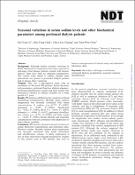
Loading...
Name
attachment.pdf
Size
349.23 KB
Format
Adobe PDF
Checksum
(MD5):a6b2e93f4acb46a63b73c619c520eb14
Loading...
Name
attachment2.pdf
Size
40.38 KB
Format
Adobe PDF
Checksum
(MD5):b7a768103e4dcccbd9e7b463a13b2fac