Options
In Vitro Stage-Specific Chondrogenesis of Mesenchymal Stem Cells Committed to Chondrocytes
Type
article
Resource
Arthritis Rheum.60(2):450-9.
Date Issued
2009
Author(s)
Chen WH; Lai MT; Wu ATH; Wu CC; Gelovani JG; Lin CT; Hung SC; Chiu WT; Deng WP
Subjects
學科:放射線學科
期刊論文
Abstract
OBJECTIVE: Osteoarthritis is characterized by an imbalance in cartilage homeostasis, which could potentially be corrected by mesenchymal stem cell (MSC)-based therapies. However, in vivo implantation of undifferentiated MSCs has led to unexpected results. This study was undertaken to establish a model for preconditioning of MSCs toward chondrogenesis as a more effective clinical tool for cartilage regeneration.
METHODS: A coculture preconditioning system was used to improve the chondrogenic potential of human MSCs and to study the detailed stages of chondrogenesis of MSCs, using a human MSC line, Kp-hMSC, in commitment cocultures with a human chondrocyte line, hPi (labeled with green fluorescent protein [GFP]). In addition, committed MSCs were seeded into a collagen scaffold and analyzed for their neocartilage-forming ability.
RESULTS: Coculture of hPi-GFP chondrocytes with Kp-hMSCs induced chondrogenesis, as indicated by the increased expression of chondrogenic genes and accumulation of chondrogenic matrix, but with no effect on osteogenic markers. The chondrogenic process of committed MSCs was initiated with highly activated chondrogenic adhesion molecules and stimulated cartilage developmental growth factors, including members of the transforming growth factor beta superfamily and their downstream regulators, the Smads, as well as endothelial growth factor, fibroblast growth factor, insulin-like growth factor, and vascular endothelial growth factor. Furthermore, committed Kp-hMSCs acquired neocartilage-forming potential within the collagen scaffold.
CONCLUSION: These findings help define the molecular markers of chondrogenesis and more accurately delineate the stages of chondrogenesis during chondrocytic differentiation of human MSCs. The results indicate that human MSCs committed to the chondroprogenitor stage of chondrocytic differentiation undergo detailed chondrogenic changes. This model of in vitro chondrogenesis of human MSCs represents an advance in cell-based transplantation for future clinical use
METHODS: A coculture preconditioning system was used to improve the chondrogenic potential of human MSCs and to study the detailed stages of chondrogenesis of MSCs, using a human MSC line, Kp-hMSC, in commitment cocultures with a human chondrocyte line, hPi (labeled with green fluorescent protein [GFP]). In addition, committed MSCs were seeded into a collagen scaffold and analyzed for their neocartilage-forming ability.
RESULTS: Coculture of hPi-GFP chondrocytes with Kp-hMSCs induced chondrogenesis, as indicated by the increased expression of chondrogenic genes and accumulation of chondrogenic matrix, but with no effect on osteogenic markers. The chondrogenic process of committed MSCs was initiated with highly activated chondrogenic adhesion molecules and stimulated cartilage developmental growth factors, including members of the transforming growth factor beta superfamily and their downstream regulators, the Smads, as well as endothelial growth factor, fibroblast growth factor, insulin-like growth factor, and vascular endothelial growth factor. Furthermore, committed Kp-hMSCs acquired neocartilage-forming potential within the collagen scaffold.
CONCLUSION: These findings help define the molecular markers of chondrogenesis and more accurately delineate the stages of chondrogenesis during chondrocytic differentiation of human MSCs. The results indicate that human MSCs committed to the chondroprogenitor stage of chondrocytic differentiation undergo detailed chondrogenic changes. This model of in vitro chondrogenesis of human MSCs represents an advance in cell-based transplantation for future clinical use
File(s)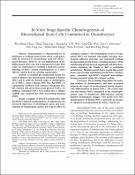
Loading...
Name
attachment.pdf
Size
231.31 KB
Format
Adobe PDF
Checksum
(MD5):66fbdaaf023599aad54912b85d63d1f0
Loading...
Name
attachment2.pdf
Size
41.62 KB
Format
Adobe PDF
Checksum
(MD5):9053114d12f7deb0abde2b10889f53fa