Options
Long-term psychological outcome of 1999 Taiwan earthquake survivors: a survey of a high-risk sample with property damage.
Type
article
Resource
Comprehensive Psychiatry.(48):269-275.
Date Issued
2007
Author(s)
Chen CH; Tan HK; Liao LR; Chen HH; Chan CC; Cheng JJ; Chen CY; Wang TN; Lu ML
Subjects
學科:精神學科
期刊論文
Abstract
OBJECTIVE: Severe natural disasters can cause long-term psychological impact on the survivors. This study aimed to examine the prevalence and risk factors of posttraumatic stress symptoms and psychiatric morbidity among survivors of the severe earthquake that occurred in Chi-Chi, Taiwan, in September 21, 1999.
METHODS: A total of 6412 earthquake survivors whose houses were destroyed by earthquake were recruited about 2 years after the disaster. They completed a self-report questionnaire assessing posttraumatic stress symptoms, psychiatric morbidity, and information of demographics, trauma exposure, and current living status.
RESULTS: The estimated rates of posttraumatic stress disorder caseness and psychiatric morbidity were 20.9% and 39.8%, respectively. Psychiatric morbidity occurred mainly in survivors who were female, older, with low education level, and currently living in a prefabricated house. The risk factors for posttraumatic stress disorder caseness were female sex, currently living in a prefabricated house, low education level, and experienced complete destruction of property.
CONCLUSION: These results showed that severe earthquake can cause long-term psychological impact in the survivors. The findings of risk factors suggest avenues for targeting postdisaster interventions
METHODS: A total of 6412 earthquake survivors whose houses were destroyed by earthquake were recruited about 2 years after the disaster. They completed a self-report questionnaire assessing posttraumatic stress symptoms, psychiatric morbidity, and information of demographics, trauma exposure, and current living status.
RESULTS: The estimated rates of posttraumatic stress disorder caseness and psychiatric morbidity were 20.9% and 39.8%, respectively. Psychiatric morbidity occurred mainly in survivors who were female, older, with low education level, and currently living in a prefabricated house. The risk factors for posttraumatic stress disorder caseness were female sex, currently living in a prefabricated house, low education level, and experienced complete destruction of property.
CONCLUSION: These results showed that severe earthquake can cause long-term psychological impact in the survivors. The findings of risk factors suggest avenues for targeting postdisaster interventions
File(s)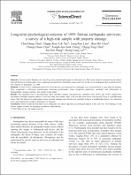
Loading...
Name
attachment.pdf
Size
146.43 KB
Format
Adobe PDF
Checksum
(MD5):24a45469f9071dcb4c11ad016cdd37e3
Loading...
Name
attachment2.pdf
Size
36.1 KB
Format
Adobe PDF
Checksum
(MD5):b6905ad6675b7d0dfe7e75936786aed0