Options
Effect of Previous Live Birth and Prior Route of Delivery on the Outcome of Early Medical Abortion
Type
article
Resource
The American College of Obstetricians and Gynecologists.113(3):669-674.
Date Issued
2009-03
Author(s)
Subjects
臺北醫學大學附設醫院
科部:婦產部
類別:期刊論文
Abstract
OBJECTIVE: To determine the association between type
of previous delivery (vaginal compared with cesarean) on
the success of medical abortion with mifepristone–misoprostol
in early pregnancy.
METHODS: The records of 879 women with intrauterine
pregnancies at or before 56 days of gestation who underwent
medical abortions were reviewed. Medical
treatment consisted of 600 mg mifepristone orally followed
48 hours later with oral misoprostol. An ultrasound
examination was performed 14–21 days after treatment,
and a successful medical abortion was defined as an
empty uterus without surgical intervention. Univariable
and multivariable logistic regressions were used to determine
risk factors for failure of medical abortion.
RESULTS: A total of 797 (90.7%) women had successful
medical abortions; 82 (9.3%) had failed medical abortions.
Multivariable logistic regression indicated that
women with gestational ages greater than 42 days (odds
ratio [OR] 2.53, 95% confidence interval [CI] 1.55– 4.05)
had higher odds of failed abortion compared with a
gestational age less than 43 days. Parous women
(OR>3.94, 95% CI 1.83– 8.53) and those with prior cesarean
delivery (OR 9.59, 95% CI 4.30 –21.39) were more
likely to have failed abortions compared with nulliparous
women. Among 523 parous women (68 had failed abortion),
those with gestational ages greater than 42 days
(OR 2.07, 95% CI 1.22–3.50) and prior cesarean delivery
(OR 3.33, 95% CI 1.95–5.69) were more likely to have
failed abortions compared with those with gestational
ages less than 43 days or with prior vaginal delivery.
CONCLUSION: Parous women are at increased risk for
failed medical abortion in comparison with nulliparous
women. Prior cesarean delivery is significantly associated
with failed medical abortion.
of previous delivery (vaginal compared with cesarean) on
the success of medical abortion with mifepristone–misoprostol
in early pregnancy.
METHODS: The records of 879 women with intrauterine
pregnancies at or before 56 days of gestation who underwent
medical abortions were reviewed. Medical
treatment consisted of 600 mg mifepristone orally followed
48 hours later with oral misoprostol. An ultrasound
examination was performed 14–21 days after treatment,
and a successful medical abortion was defined as an
empty uterus without surgical intervention. Univariable
and multivariable logistic regressions were used to determine
risk factors for failure of medical abortion.
RESULTS: A total of 797 (90.7%) women had successful
medical abortions; 82 (9.3%) had failed medical abortions.
Multivariable logistic regression indicated that
women with gestational ages greater than 42 days (odds
ratio [OR] 2.53, 95% confidence interval [CI] 1.55– 4.05)
had higher odds of failed abortion compared with a
gestational age less than 43 days. Parous women
(OR>3.94, 95% CI 1.83– 8.53) and those with prior cesarean
delivery (OR 9.59, 95% CI 4.30 –21.39) were more
likely to have failed abortions compared with nulliparous
women. Among 523 parous women (68 had failed abortion),
those with gestational ages greater than 42 days
(OR 2.07, 95% CI 1.22–3.50) and prior cesarean delivery
(OR 3.33, 95% CI 1.95–5.69) were more likely to have
failed abortions compared with those with gestational
ages less than 43 days or with prior vaginal delivery.
CONCLUSION: Parous women are at increased risk for
failed medical abortion in comparison with nulliparous
women. Prior cesarean delivery is significantly associated
with failed medical abortion.
File(s)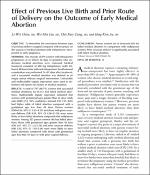
Loading...
Name
attachment.pdf
Size
112.98 KB
Format
Adobe PDF
Checksum
(MD5):d9fc0e287df243c578d42cb27d6e7405