Options
Chinese version of the Delirium Rating Scale-Revised-98: reliability and validity
Type
article
Resource
Comp Psychiatry.(50):81-85.
Date Issued
2009
Author(s)
Huang MC; Lee CH; Lai YC; Kao YF; Lin HY; Chen CH
Subjects
學科:精神學科
期刊論文
Abstract
Background
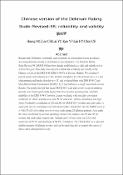
Delirium is commonly seen in patients in consultation-liaison psychiatry. Assessing delirium severity is important in clinical practice. The Delirium Rating Scale-Revised-98 (DRS-R-98) has been already established as a valid and reliable tool to achieve this goal. This study was aimed to evaluate the reliability and validity of the Chinese version of the DRS-R-98 (DRS-R-98-C) in Taiwan.
Method
We recruited 4 patient groups with delirium (n = 28), alcohol dependence (n = 9), dementia (n =11), and schizophrenia and bipolar disorder (n = 11) and evaluated them with DRS-R-98-C and Mini-Mental Status Examination (MMSE) by 2 psychiatrists at a single assessment session.
Results
The results showed that mean DRS-R-98-C total and severity scores in delirious patients were found significantly higher than those in other patient groups. Interrater reliability of the DRS-R-98-C between 2 raters was high, with intraclass correlation coefficient of .98 for severity scale and .99 for total scale. Internal consistency was high with a Cronbach's α coefficient of .85 and .86 for DRS-R-98-C severity and total scales. A significant inverse correlation was found between the DRS-R-98-C and the MMSE score (r = −0.63, P < .001) for either severity or total scale among 28 delirious patients. Area under the curve established by receiver operating characteristic analysis was .93 and .96 for severity and total scales, respectively. Optimal cutoff of total score was 15.5, with sensitivity of 89.3% and specificity of 96.8%.
Conclusion
The DRS-R-98-C is a valid and reliable measure of delirium severity and can be used clinically to monitor the course of illness when administered serially.
Delirium is commonly seen in patients in consultation-liaison psychiatry. Assessing delirium severity is important in clinical practice. The Delirium Rating Scale-Revised-98 (DRS-R-98) has been already established as a valid and reliable tool to achieve this goal. This study was aimed to evaluate the reliability and validity of the Chinese version of the DRS-R-98 (DRS-R-98-C) in Taiwan.
Method
We recruited 4 patient groups with delirium (n = 28), alcohol dependence (n = 9), dementia (n =11), and schizophrenia and bipolar disorder (n = 11) and evaluated them with DRS-R-98-C and Mini-Mental Status Examination (MMSE) by 2 psychiatrists at a single assessment session.
Results
The results showed that mean DRS-R-98-C total and severity scores in delirious patients were found significantly higher than those in other patient groups. Interrater reliability of the DRS-R-98-C between 2 raters was high, with intraclass correlation coefficient of .98 for severity scale and .99 for total scale. Internal consistency was high with a Cronbach's α coefficient of .85 and .86 for DRS-R-98-C severity and total scales. A significant inverse correlation was found between the DRS-R-98-C and the MMSE score (r = −0.63, P < .001) for either severity or total scale among 28 delirious patients. Area under the curve established by receiver operating characteristic analysis was .93 and .96 for severity and total scales, respectively. Optimal cutoff of total score was 15.5, with sensitivity of 89.3% and specificity of 96.8%.
Conclusion
The DRS-R-98-C is a valid and reliable measure of delirium severity and can be used clinically to monitor the course of illness when administered serially.
File(s)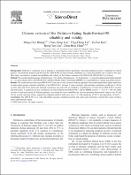
Loading...
Name
attachment.pdf
Size
178.54 KB
Format
Adobe PDF
Checksum
(MD5):ebced4dfc19df91dadea7335859786a7
Loading...
Name
attachment2.pdf
Size
39.25 KB
Format
Adobe PDF
Checksum
(MD5):ec9622c6111351195707b54b9369cf0a