Options
Patient Perceptions of Service Quality in Group versus Solo
Type
article
Resource
International Journal for Quality in Health Care.(16):437-445.
Date Issued
2004
Author(s)
Subjects
醫務管理學系
期刊論文
Abstract
Objective. To compare patient perceptions of service quality at solo and group practices, and to examine the association of perceptions with ‘potential patient loyalty’ (PPL), the potential for seeking future service from the same clinic.
Design. A self-administered, cross-sectional survey of clinic outpatients, using an adapted SERVQUAL questionnaire translated into Chinese, with additional items on overall satisfaction and intent to return/recommend the clinic to others.
Sampling and study subjects. Every third outpatient at all newly started group practices (four) and solo clinics (thirteen) in Taiwan in the preceding 4–7 months, including 150 and 50 patients from each group and solo practice, respectively, for a total of 1250 patients.
Main outcome measures. Perceived service quality on five dimensions—tangibles, reliability, responsiveness, assurance, and empathy—and PPL. All constructs were measured on a five-point scale.
Results. After accounting for random effects of clinical and geographical location, group practice patients perceived significantly higher service quality on all dimensions relative to solo practice patients, after adjusting for age, gender, education, and illness type. All service quality dimensions except assurance were significantly positively associated with PPL after adjusting for age, gender, education, and illness type, and random effects at the clinical and geographical location levels.
Conclusions. Patients perceive better service quality at group practices compared with solo practices on all dimensions. Patients’ quality perceptions are significant predictors of PPL. The implications for physician practices both internationally and in Taiwan are discussed, as well as policy implications for the Taiwan government.
Design. A self-administered, cross-sectional survey of clinic outpatients, using an adapted SERVQUAL questionnaire translated into Chinese, with additional items on overall satisfaction and intent to return/recommend the clinic to others.
Sampling and study subjects. Every third outpatient at all newly started group practices (four) and solo clinics (thirteen) in Taiwan in the preceding 4–7 months, including 150 and 50 patients from each group and solo practice, respectively, for a total of 1250 patients.
Main outcome measures. Perceived service quality on five dimensions—tangibles, reliability, responsiveness, assurance, and empathy—and PPL. All constructs were measured on a five-point scale.
Results. After accounting for random effects of clinical and geographical location, group practice patients perceived significantly higher service quality on all dimensions relative to solo practice patients, after adjusting for age, gender, education, and illness type. All service quality dimensions except assurance were significantly positively associated with PPL after adjusting for age, gender, education, and illness type, and random effects at the clinical and geographical location levels.
Conclusions. Patients perceive better service quality at group practices compared with solo practices on all dimensions. Patients’ quality perceptions are significant predictors of PPL. The implications for physician practices both internationally and in Taiwan are discussed, as well as policy implications for the Taiwan government.
File(s)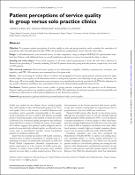
Loading...
Name
attachment.pdf
Size
116.52 KB
Format
Adobe PDF
Checksum
(MD5):a9600f534f3a9431f42ba1d30a8b1c34
Loading...
Name
attachment2.pdf
Size
34.79 KB
Format
Adobe PDF
Checksum
(MD5):b3099d68141b898f236efd7a12c4196b