Options
Quercetin inhibition of ROS-dependent and –independent apoptosis in rat glioma C6 cells
Type
article
Resource
Toxicology.(223):113-126.
Date Issued
2006
Author(s)
陳彥州
TJ Chen; JY Jeng; CW Lin; CY Lin; YC Chen;
Subjects
醫學科學研究所
期刊論文
Abstract
In the present study, we investigated the protective mechanism of quercetin (QUE) and its glycosides, rutin (RUT) and quercitrin (QUI), on reactive oxygen species (ROS)-dependent (H(2)O(2)) and -independent (chemical anoxia) cell death in rat glioma C6 cells. Induction of HO-1 protein expression was detected in QUE- but not RUT- or QUI-treated C6 cells, and this was prevented by cycloheximide and actinomycin D. Incubation of C6 cells with QUE, but not RUT or QUI, protected C6 cells from H(2)O(2)- and chemical anoxia-induced cytotoxicity according to the MTT and LDH release assays. Apoptotic characteristics including chromatin condensation, DNA ladders, and hypodiploid cells appeared in H(2)O(2)-and chemical anoxia-treated C6 cells, and those events were significantly suppressed by adding QUE (but not RUT or QUI). Increases in caspase 3, 8, and 9 enzyme activities with decreases in pro-PARP and pro-caspase 3 protein levels and an increase in cleaved D4-GDI protein were identified in H(2)O(2)-and chemical anoxia-treated C6 cells, and these were blocked by the addition of QUE, but not by RUT or QUI. Intracellular peroxide levels increased with H(2)O(2) and decreased with chemical anoxia, and the addition of QUE reduced the intracellular peroxide levels induced by H(2)O(2). Results of an anti-DPPH radical assay showed that QUE, RUT, and QUI dose-dependently inhibited the production of DPPH radicals in vitro; however, QUE (but not RUT or QUI) prevention of DNA damage induced by OH radicals was identified with a plasmid digestion assay. Increases in phosphorylated ERK and p53 protein expressions were detected in H(2)O(2)- but not chemical anoxia-treated C6 cells, and the addition of QUE significantly blocked H(2)O(2)-induced phosphorylated ERK and p53 protein expressions. Adding the HO-1 inhibitors, SnPP, CoPP, and ZnPP, reversed the protective effect of QUE against H(2)O(2)- and chemical anoxia-induced cell death according to the MTT assay and morphological observations. Additionally, QUE exhibited inhibitory effects on LPS/TPA-induced transformation in accordance with a decrease in MMP-9 enzyme activity and iNOS protein expression in C6 cells. Taken together, the results of this study suggest that QUE exhibits an inhibitory effect on both ROS-dependent and -independent cell death, and induction of HO-1 protein expression is involved.
File(s)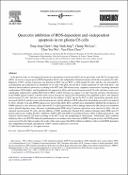
Loading...
Name
attachment.pdf
Size
1.27 MB
Format
Adobe PDF
Checksum
(MD5):55ad053b17695767dfdab4807625d5eb
Loading...
Name
attachment2.pdf
Size
33.71 KB
Format
Adobe PDF
Checksum
(MD5):0fbe8943c0f66a8f859498a523d727eb