Options
Cisplatin encapsulated in phosphatidylethanolamine liposomes enhances the in vitro cytotoxicity and in vivo intratumor drug accumulation against melanomas
Type
article
Resource
J. Dermatol Sci.(46):11-20.
Date Issued
2007
Author(s)
Hwang TL; Lee WR; Hua SC; Fang JY
Subjects
臨床醫學研究所
期刊論文
Abstract
BACKGROUND: Cisplatin is a potent anticancer drug for treating melanoma. OBJECTIVE: The aim of this study was to evaluate the possibility of using liposomes, for intratumoral distribution in a melanoma, composed of phosphatidylethanolamine (PE), for its cytotoxicity. METHOD: The in vitro drug release, in vitro cytotoxicity against melanoma, and in vivo residence time in the tumor of liposome-encapsulated cisplatin were investigated. The liposomes were prepared and characterized in terms of their morphology, size, zeta potential, and drug loading. RESULT: The size of the PE liposomes attained a level of approximately 100 nm. The concentration of cisplatin encapsulated in PE liposomes was 50-70% dependent on the presence or absence of polyethylene glycol (PEG) derivatives. On the other hand, no or negligible cisplatin molecules were encapsulated in egg phosphatidylcholine (EPC) liposomes. PE liposomes had higher cytotoxicity than classic liposomes or free cisplatin. Images of confocal laser scanning microscopy confirmed the great potency of PE liposomes to deliver cisplatin into cells. The incorporation of PEG derivatives completely inhibited the proliferation of melanoma cells. With in vivo intratumoral administration, the cisplatin concentration in the tumor tissue was maintained at a high level for 72 h after application of the PE liposomes. The PE liposomes delivered cisplatin into the tumor approximately 3.6 times more efficiently than the free drug. CONCLUSION: These results demonstrate that PE liposomes represent a potentially useful strategy for targeting cisplatin delivery into melanomas.
File(s)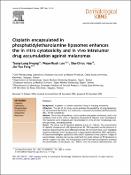
Loading...
Name
attachment.pdf
Size
605.34 KB
Format
Adobe PDF
Checksum
(MD5):67c44d5a81db4a76bb3210cd43826aa6
Loading...
Name
attachment2.pdf
Size
34.88 KB
Format
Adobe PDF
Checksum
(MD5):d4ab0d8c724e467773ee858c43354d65