Options
大學生體位狀態與父母親體位狀態關係性調查
Type
other
Date Issued
2007-06
Author(s)
Yan-Han Yu
Shu-Hui Yang
Subjects
保健營養學系
海報
Abstract
The global epidemic of overweight and obesity - "globesity" - is rapidly becoming a major
public health problem and further, the new burden in many parts of the world.World Health
Organization (WHO)’s previousdata release indicates that in 2005 more than 1 billion adults were
overweight globally, and at least 300 million of them obese. Global upsurge in overweight and
obesity is now confirmed to be attributable to the synergistic effect of exogenous and endogenous
factors. The dramatic shift in diet pattern and trend towards sedentary life style take place while
genetic predisposition lies underneath.
The purpose of this study is to confirm the idea of obesigenic predisposition and assess the
possible relationship between parental BMI and the BMI status of their offspring when other
exogenous factors are excluded. A total sample of 98 subjects were recruited from junior college
students, aged 20~22 yr, in the school of nutrition and health sciences at Taipei Medical University
in March, 2007. The BMI of the students and their parents were calculated from self-reported
weight and height. BMI cut-off points for being overweight and obese are >24(kg/m2) and
>27(kg/m2) respectively, according to the BMI standard reference for adult set by department of
Health, Executive Yuan, Taiwan. The prevalence of overweight and obesity was calculated and
logistic regressions were performed. Of total population in parents(n=189),34% were considered
overweight,12% to be obese.While only 9% and 1% to be considered overweight and obese in
the total population of 98 in offspring. Among those who were overweight, male tended to have
higher ratios than their female counterparts: for male ,46%and 23%were overweight in parents and
offspring respectively, 22% and 5% were the ratios for female. A total of 47 students who were
from families without parental overweight, 2%(n=1) of them found to be overweight. Of the
families with either parental overweight, 8%(n=3) had an overweight offspring, while on the other
hand, the presence of both parental overweight had a much higher ratio of 42%(n=5) for having an
overweight offspring. Of the total population of maternal overweight, 27%(n=6) of them had an
overweight offspring, while 17%(n=7) was the ratio for paternal overweight. A significant
difference of gender disparity on obesigenic predisposition might be suggested from the data.
Keywords: BMI, parent, offspring , overweight, obesigenic predisposition
public health problem and further, the new burden in many parts of the world.World Health
Organization (WHO)’s previousdata release indicates that in 2005 more than 1 billion adults were
overweight globally, and at least 300 million of them obese. Global upsurge in overweight and
obesity is now confirmed to be attributable to the synergistic effect of exogenous and endogenous
factors. The dramatic shift in diet pattern and trend towards sedentary life style take place while
genetic predisposition lies underneath.
The purpose of this study is to confirm the idea of obesigenic predisposition and assess the
possible relationship between parental BMI and the BMI status of their offspring when other
exogenous factors are excluded. A total sample of 98 subjects were recruited from junior college
students, aged 20~22 yr, in the school of nutrition and health sciences at Taipei Medical University
in March, 2007. The BMI of the students and their parents were calculated from self-reported
weight and height. BMI cut-off points for being overweight and obese are >24(kg/m2) and
>27(kg/m2) respectively, according to the BMI standard reference for adult set by department of
Health, Executive Yuan, Taiwan. The prevalence of overweight and obesity was calculated and
logistic regressions were performed. Of total population in parents(n=189),34% were considered
overweight,12% to be obese.While only 9% and 1% to be considered overweight and obese in
the total population of 98 in offspring. Among those who were overweight, male tended to have
higher ratios than their female counterparts: for male ,46%and 23%were overweight in parents and
offspring respectively, 22% and 5% were the ratios for female. A total of 47 students who were
from families without parental overweight, 2%(n=1) of them found to be overweight. Of the
families with either parental overweight, 8%(n=3) had an overweight offspring, while on the other
hand, the presence of both parental overweight had a much higher ratio of 42%(n=5) for having an
overweight offspring. Of the total population of maternal overweight, 27%(n=6) of them had an
overweight offspring, while 17%(n=7) was the ratio for paternal overweight. A significant
difference of gender disparity on obesigenic predisposition might be suggested from the data.
Keywords: BMI, parent, offspring , overweight, obesigenic predisposition
File(s)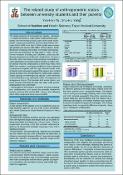
Loading...
Name
attachment.pdf
Size
185.9 KB
Format
Adobe PDF
Checksum
(MD5):21497dba3bf56fd1ef837aab8bd2852c