Options
The impacts of a school-wide no smoking strategy and classroom-based smoking prevention curriculum on the smoking behavior of junior high school students
Type
article
Resource
Addictive Behaviors.(32):2099-2107.
Date Issued
2007
Author(s)
Lee PH; Wu DM; Lai HR; Chu NF
Subjects
護理學系
期刊論文
Abstract
BACKGROUND: This study aimed at exploring the impacts of a school-wide no smoking strategy and a classroom-based smoking prevention curriculum on smoking-related knowledge, attitude, behavior, and skill of junior high school students.
METHODS: Using a pre-post quasi-experimental design, 469 seventh-to ninth-grade students at four junior high schools in Taiwan, were selected and separated into three groups according to class unit. Experimental group A experienced a school-wide no smoking strategy and a six-session smoking prevention curriculum. Experimental group B experienced only the school-wide no smoking strategy. The control group experienced no intervention. The students were tested 1 week before intervention began and 1 week after it ended.
RESULTS: Experimental group A exhibited a better understanding than either experimental group B or the control group of the dangers of smoking and of techniques for refusing cigarettes; and in fact, group A indicated low smoking intention than experimental group B. Experimental group A also had a better attitudes towards resisting smoking than the control group. However, the intervention had no demonstrable effect on the smoking behavior and on the smoking substitution methods of students.
CONCLUSIONS: To reduce the smoking rates among junior high school students, diversified school-wide no smoking strategies and standardized, diversified instruments should be adopted so that outcomes of smoking prevention work may be assessed more objectively and effectively.
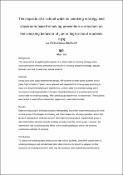
METHODS: Using a pre-post quasi-experimental design, 469 seventh-to ninth-grade students at four junior high schools in Taiwan, were selected and separated into three groups according to class unit. Experimental group A experienced a school-wide no smoking strategy and a six-session smoking prevention curriculum. Experimental group B experienced only the school-wide no smoking strategy. The control group experienced no intervention. The students were tested 1 week before intervention began and 1 week after it ended.
RESULTS: Experimental group A exhibited a better understanding than either experimental group B or the control group of the dangers of smoking and of techniques for refusing cigarettes; and in fact, group A indicated low smoking intention than experimental group B. Experimental group A also had a better attitudes towards resisting smoking than the control group. However, the intervention had no demonstrable effect on the smoking behavior and on the smoking substitution methods of students.
CONCLUSIONS: To reduce the smoking rates among junior high school students, diversified school-wide no smoking strategies and standardized, diversified instruments should be adopted so that outcomes of smoking prevention work may be assessed more objectively and effectively.
File(s)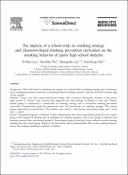
Loading...
Name
attachment.pdf
Size
150.57 KB
Format
Adobe PDF
Checksum
(MD5):a35af822be3a3d06e5c34eb47b5edc84
Loading...
Name
attachment2.pdf
Size
60.32 KB
Format
Adobe PDF
Checksum
(MD5):df1d725172037d1fdc9ca16a347972e8