Options
Mechanisms involved in the antiplatelet activity of rutin, a glycoside of the flavonol quercetin, in human platelets.
Type
article
Resource
J Agric Food Chem.(52):4414-4418
Date Issued
2004
Author(s)
周敦穗; 蕭哲志
Sheu JR; Hsiao G; Chou PH; Shen MY; Chou DS;
Subjects
學科:藥理學科
期刊論文
Abstract
The aim of this study was to systematically examine the inhibitory mechanisms of rutin, a well-known flavonoid in platelet aggregation. In this study, rutin concentration-dependently (250 and 290 microM) inhibited platelet aggregation in human platelets stimulated by agonists (i.e., collagen). Rutin (250 and 290 microM) did not significantly interfere with the binding of FITC-triflavin to the glycoprotein IIb/IIIa complex in human platelets. Rutin (250 and 290 microM) markedly inhibited intracellular Ca(2+) mobilization and thromboxane A(2) formation in human platelets stimulated by collagen. Rapid phosphorylation of a platelet protein of M(r) 47000 (P47), a marker of protein kinase C activation, was triggered by collagen (1 microg/mL). This phosphorylation was markedly inhibited by rutin (250 and 290 microM). On the other hand, rutin (250 and 290 microM) did not significantly increase the formations of cyclic AMP and nitric oxide/cyclic GMP in platelets. In conclusion, these results indicate that the antiplatelet activity of rutin may involve the following pathways: rutin inhibited the activation of phospholipase C, followed by inhibition of protein kinase C activity and thromboxane A(2) formation, thereby leading to inhibition of the phosphorylation of P47 and intracellular Ca(2+) mobilization, finally resulting in inhibition of platelet aggregation.
File(s)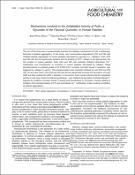
Loading...
Name
attachment.pdf
Size
75.63 KB
Format
Adobe PDF
Checksum
(MD5):6e22c6a0b6765e47cfc49177b60b43a7
Loading...
Name
attachment2.pdf
Size
37.21 KB
Format
Adobe PDF
Checksum
(MD5):5453df471d3924f3464147e92931db5c