Options
Pluripotency of mouse spermatogonial stem cells maintained by IGF-1-dependent pathway
Type
article
Resource
The FASEB Journal.
Date Issued
2009
Author(s)
Huang YH; Chin CC; Ho HN; Chou CK; Shen CN; Kuo HC; Wu TJ; Wu YC; Hung YC; Chang CC; Ling TY
Subjects
學科:生物化學暨細胞分子生物學科
期刊論文
Abstract
Recent studies indicate that neonatal spermatogonial stem cells (SSCs) possess pluripotency. However, the mechanisms that regulate the pluripotent differentiation capacity of SSCs remain unclear. Here, we describe a new method to clonally derive pluripotent SSCs from neonatal mouse testis. By coculturing with testicular stromal cells, SSCs can be maintained and expanded in serum-free conditions. Unlike endogenous SSCs, these in vitro expanded SSCs showed strong alkaline phosphatase (AP) activity and displayed characteristics of embryonic stem cells and primordial germ cells, which were therefore designated as AP(+) germline stem cells (AP(+)GSCs). The pluripotency of AP(+)GSCs was confirmed by in vitro differentiation toward hepatic and neuronal lineages and formation of embryonic chimeras after injection into blastocysts. Further investigation revealed that insulin-like growth factor-1 (IGF-1) secreted from Leydig cells was a key factor involved in maintaining the pluripotency of AP(+)GSCs. The blockage of IGF-1 receptor phosphorylation and its downstream PI3K pathway by PPP or LY294002 dramatically reduced their AP activity and expression of pluripotent genes, such as Oct-4, Blimp1, and Nanog. In conclusion, the present study demonstrated that IGF-1 secreted by testicular Leydig cells plays an important role in maintaining the pluripotency of SSCs in culture, which provides an insight into the molecular mechanism underlying germ cell pluripotency.
File(s)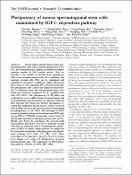
Loading...
Name
attachment.pdf
Size
1.5 MB
Format
Adobe PDF
Checksum
(MD5):6dd203c518f1c9cabefdad29340d167b
Loading...
Name
attachment2.pdf
Size
36.93 KB
Format
Adobe PDF
Checksum
(MD5):b0e0d3e46fca70f7b5a9d915e08a6cfe