Options
Dihydrolipoic acid inhibits skin tumor promotion through anti-inflammation and anti-oxidation
Type
article
Resource
Biochemical Pharmacology.(73):1786-1795.
Date Issued
2007
Author(s)
何元順
Yuan-Soon Ho
Ching-Shu Lai
Hsin-I Liu
Sheng-Yow Ho
Chein Tai
Min-Hsiung Pan
Ying-Jan Wang
Subjects
醫學檢驗暨生物技術學系
期刊論文
Abstract
a-Lipoic acid (LA) has been intensely investigated as a therapeutic agent for several diseases,
including hepatic disorder and diabetic polyneuropathy. However, the effects of LA or its
reduced form, dihydrolipoic acid (DHLA), on cancer chemoprevention has never been
reported. In the present study, we examined the effects of DHLA/LA on the production of
nitric oxide (NO) by inducible NO synthase (iNOS) and the formation of prostaglandin E2
(PGE2) by cyclooxygenase-2 (COX-2), two important mediators associated with inflammation.
DHLA/LA significantly inhibited lipopolysaccharide (LPS)-induced NO and PGE2 formation
in RAW 264.7 cells. Meanwhile, treatment with DHLA/LA suppressed the
expression of iNOS protein but, unexpectedly, did not affect or increase the expression
of COX-2 protein. The in vivo anti-inflammatory and antitumor-promoting activities were
evaluated by a topical 12-O-tetradecanoylphorbol 13-acetate (TPA) application to mouse
skin withmeasurement of edema formation, epidermal thickness and hydrogen peroxide
production. DHLA significantly inhibited the priming and activation stages of skin inflammation
induced by a double TPA application, by decreasing the inflammatory parameters.
Furthermore, DHLA inhibited DMBA (0.3 mmol)/TPA (2.0 nmol)-induced skin tumor formation
by reducing the tumor incidence and tumor multiplicity. When applied topically
onto the shaven backs of mice prior to TPA, DHLA markedly inhibited the expression of
iNOS protein. DHLA also strongly and directly inhibited COX-2 activity. These results
suggest that DHLA can be a possible chemopreventive agent in inflammation-associated
tumorigenesis.
including hepatic disorder and diabetic polyneuropathy. However, the effects of LA or its
reduced form, dihydrolipoic acid (DHLA), on cancer chemoprevention has never been
reported. In the present study, we examined the effects of DHLA/LA on the production of
nitric oxide (NO) by inducible NO synthase (iNOS) and the formation of prostaglandin E2
(PGE2) by cyclooxygenase-2 (COX-2), two important mediators associated with inflammation.
DHLA/LA significantly inhibited lipopolysaccharide (LPS)-induced NO and PGE2 formation
in RAW 264.7 cells. Meanwhile, treatment with DHLA/LA suppressed the
expression of iNOS protein but, unexpectedly, did not affect or increase the expression
of COX-2 protein. The in vivo anti-inflammatory and antitumor-promoting activities were
evaluated by a topical 12-O-tetradecanoylphorbol 13-acetate (TPA) application to mouse
skin withmeasurement of edema formation, epidermal thickness and hydrogen peroxide
production. DHLA significantly inhibited the priming and activation stages of skin inflammation
induced by a double TPA application, by decreasing the inflammatory parameters.
Furthermore, DHLA inhibited DMBA (0.3 mmol)/TPA (2.0 nmol)-induced skin tumor formation
by reducing the tumor incidence and tumor multiplicity. When applied topically
onto the shaven backs of mice prior to TPA, DHLA markedly inhibited the expression of
iNOS protein. DHLA also strongly and directly inhibited COX-2 activity. These results
suggest that DHLA can be a possible chemopreventive agent in inflammation-associated
tumorigenesis.
alpha-Lipoic acid (LA) has been intensely investigated as a therapeutic agent for several diseases, including hepatic disorder and diabetic polyneuropathy. However, the effects of LA or its reduced form, dihydrolipoic acid (DHLA), on cancer chemoprevention has never been reported. In the present study, we examined the effects of DHLA/LA on the production of nitric oxide (NO) by inducible NO synthase (iNOS) and the formation of prostaglandin E2 (PGE(2)) by cyclooxygenase-2 (COX-2), two important mediators associated with inflammation. DHLA/LA significantly inhibited lipopolysaccharide (LPS)-induced NO and PGE(2) formation in RAW 264.7 cells. Meanwhile, treatment with DHLA/LA suppressed the expression of iNOS protein but, unexpectedly, did not affect or increase the expression of COX-2 protein. The in vivo anti-inflammatory and antitumor-promoting activities were evaluated by a topical 12-O-tetradecanoylphorbol 13-acetate (TPA) application to mouse skin with measurement of edema formation, epidermal thickness and hydrogen peroxide production. DHLA significantly inhibited the priming and activation stages of skin inflammation induced by a double TPA application, by decreasing the inflammatory parameters. Furthermore, DHLA inhibited DMBA (0.3 micromol)/TPA (2.0 nmol)-induced skin tumor formation by reducing the tumor incidence and tumor multiplicity. When applied topically onto the shaven backs of mice prior to TPA, DHLA markedly inhibited the expression of iNOS protein. DHLA also strongly and directly inhibited COX-2 activity. These results suggest that DHLA can be a possible chemopreventive agent in inflammation-associated tumorigenesis.
File(s)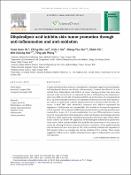
Loading...
Name
attachment.pdf
Size
1.11 MB
Format
Adobe PDF
Checksum
(MD5):6e35e524a82a200ecb7c29e95fc1134a
Loading...
Name
attachment2.pdf
Size
35.42 KB
Format
Adobe PDF
Checksum
(MD5):b314c51d84acfea8c03b8d8e70c621ae