Options
Amphetamine inhibits the N-methyl-D-aspartate receptor-mediated responses by directly interacting with the receptor/channel complex
Type
article
Resource
J Pharmacology and Experimental Therapeutics.(300):1008-1016.
Date Issued
2002
Author(s)
葉健全
Yeh; G.C.; Chen; J.C.; Tsai; H.C.; Wu; H.H.; Lin; C.Y.; Hsu; P.C.; and Peng; Y.C.
Subjects
臨床醫學研究所
期刊論文
Abstract
Amphetamine (AMPH) induces behavioral sensitization and neurotoxicity primarily by enhancing the dopamine-mediated neurotransmission. However, the involvement of the N-methyl-D-aspartate (NMDA) receptor in AMPH-induced neuropathology is also known. Recent investigation has found that high concentration of dopamine could inhibit NMDA receptor-mediated responses by blocking the NMDA receptor channel. By virtue of the structure similarity between dopamine and AMPH, we determined whether d-AMPH and its analogs, l-AMPH and methamphetamine (MAMH), could affect the NMDA receptor-mediated [3H]N-[1-(2-thienyl)cyclohexyl] piperidine ([3H]TCP) binding in rat cortical membrane preparations and intracellular 45Ca2+ accumulation and cell death in the rat primary cortical cell cultures. AMPH concentration-dependently inhibited NMDA- and glycine-stimulated [3H]TCP binding and intracellular 45Ca2+ accumulation with two distinct potencies; a minor inhibition with high potency and a major inhibition with low potency. [3H]TCP binding suggested that the high-potency inhibition was produced by decreasing agonist-induced activation of the NMDA receptor channel. On the other hand, the low-potency inhibition was produced by competing with [3H]TCP binding in the NMDA receptor channel, like the action of noncompetitive antagonist of the NMDA receptor. However, AMPH analogs were less potent in inhibiting NMDA- and glycine-induced cultured cell death. Thus, this result indicates that AMPH could antagonize the NMDA receptor-mediated responses in vitro by two different mechanisms, probably, through directly interacting with two distinct sites on this receptor/channel complex.
File(s)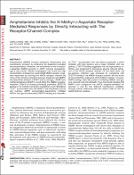
Loading...
Name
attachment.pdf
Size
358.43 KB
Format
Adobe PDF
Checksum
(MD5):77f402cf606e549ce34babfc7d706db5
Loading...
Name
attachment2.pdf
Size
36.81 KB
Format
Adobe PDF
Checksum
(MD5):abf24ec373493cd8bab67de69e1ddb19