Options
Effects of dietary intake on glucose metabolism and reproductive hormones in women with polycystic ovary syndrome. Ann. Nutr. Metab
Type
other
Resource
Ann Nutr Metab. 55 (suppl 1): pp. 194 (P11-04).
Date Issued
2009-09
Author(s)
Wang TW
Chao JC
Wei HJ
Young R
Liaw CM
Tsai YH
Lin YL
Wang SS
Subjects
保健營養學系
海報
Abstract
Objective: To understand the relationship of dietary intake on glucose metabolism and reproductive hormones in patients with polycystic ovary syndrome (PCOS) in Taiwan.
Design: Cross-sectional study.
Setting: Infertility Center, Taiwan Adventist Hospital.
Patients: Thirty-one patients with PCOS and thirty-six control infertility patients.
Intervention(s): None.
Main Outcomes Measure(s): Hormones assay, 75-g oral glucose tolerance test, 24-hour recall and 3-d dietary record.
Results: PCOS patients increased BMI and body fat percentage compared with non-PCOS patients. Significant positive correlations were observed between calorie intake and fasting blood glucose (r = 0.47, P < 0.05), fasting insulin (r = 0.37, P < 0.05), insulin resistance (r = 0.41, P < 0.05). Plasma testosterone concentration was positively correlated with dietary carbohydrate intake (r = 0.40, P < 0.01). Postprandial glucose concentration was positively correlated with dietary fat intake (r = 0.45, P < 0.05).
Conclusions: PCOS women with greater BMI and body fat impair glucose metabolism and insulin sensitivity. Fat and carbohydrate intake is positively correlated with plasma testosterone and postprandial glucose concentrations, respectively.
Design: Cross-sectional study.
Setting: Infertility Center, Taiwan Adventist Hospital.
Patients: Thirty-one patients with PCOS and thirty-six control infertility patients.
Intervention(s): None.
Main Outcomes Measure(s): Hormones assay, 75-g oral glucose tolerance test, 24-hour recall and 3-d dietary record.
Results: PCOS patients increased BMI and body fat percentage compared with non-PCOS patients. Significant positive correlations were observed between calorie intake and fasting blood glucose (r = 0.47, P < 0.05), fasting insulin (r = 0.37, P < 0.05), insulin resistance (r = 0.41, P < 0.05). Plasma testosterone concentration was positively correlated with dietary carbohydrate intake (r = 0.40, P < 0.01). Postprandial glucose concentration was positively correlated with dietary fat intake (r = 0.45, P < 0.05).
Conclusions: PCOS women with greater BMI and body fat impair glucose metabolism and insulin sensitivity. Fat and carbohydrate intake is positively correlated with plasma testosterone and postprandial glucose concentrations, respectively.
File(s)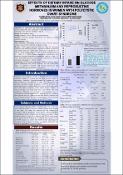
Loading...
Name
attachment.pdf
Size
1.42 MB
Format
Adobe PDF
Checksum
(MD5):8d5f167ce7a1774c1a7d642dd2a062e1