Options
Six-month nocturnal nasal positive pressure ventilation improves respiratory muscle capacity and exercise endurance in patients with chronic hypercapnic respiratory failure.
Type
article
Resource
J.Formos. Med. Assoc. 2006 ;105:459-467.(10):459-467
Date Issued
2006
Author(s)
江玲玲
Chiang L.L.Yu CT; Liu CY; Lo YL; Kuo HP; Lin HC
Subjects
呼吸治療學系
期刊論文
Abstract
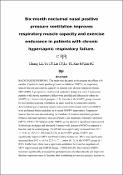
BACKGROUND/PURPOSE: This study was designed to investigate the effects of 6 months of nocturnal nasal positive pressure ventilation (NNPPV) on respiratory muscle function and exercise capacity in patients with chronic respiratory failure.
METHODS: A prospective, randomized, controlled design was used. Twenty-nine patients with chronic respiratory failure were enrolled and allocated to either the NNPPV (n = 14) or control group (n = 15). Patients in the NNPPV group received bi-level positive pressure ventilation via nasal mask for 6 consecutive months. Arterial blood gas, respiratory muscle assessment and 6-minute walk test (6MWT) were performed before and after the 6-month NNPPV intervention. Respiratory muscle function was assessed using the variables of maximal inspiratory pressure (Pimax), maximal expiratory pressure (Pemax), and maximum voluntary ventilation (MVV).
RESULTS: Subjects in the NNPPV group showed a significant improvement in blood gas exchange and increased 6-minute walk distance (6MWD) compared to baseline and the control group. The 6MWD was significantly increased from 257.1 +/- 114.1 to 345.2 +/- 109.9 m (34.3%) in the NNPPV group. NNPPV also significantly improved MVV and Pimax relative to baseline. MVV was significantly increased from 19.2 +/- 6.5 to 22.3 +/- 7.1 L/min (16.1%) in the NNPPV group (p < 0.05). Furthermore, there was a significant correlation between the magnitude of MVV improvement and 6MWD change.
CONCLUSION: The 6-month NNPPV treatment significantly decreased the partial pressure of carbon dioxide and improved daytime respiratory muscle function, thus contributing to exercise-capacity increase in patients with chronic respiratory failure.
METHODS: A prospective, randomized, controlled design was used. Twenty-nine patients with chronic respiratory failure were enrolled and allocated to either the NNPPV (n = 14) or control group (n = 15). Patients in the NNPPV group received bi-level positive pressure ventilation via nasal mask for 6 consecutive months. Arterial blood gas, respiratory muscle assessment and 6-minute walk test (6MWT) were performed before and after the 6-month NNPPV intervention. Respiratory muscle function was assessed using the variables of maximal inspiratory pressure (Pimax), maximal expiratory pressure (Pemax), and maximum voluntary ventilation (MVV).
RESULTS: Subjects in the NNPPV group showed a significant improvement in blood gas exchange and increased 6-minute walk distance (6MWD) compared to baseline and the control group. The 6MWD was significantly increased from 257.1 +/- 114.1 to 345.2 +/- 109.9 m (34.3%) in the NNPPV group. NNPPV also significantly improved MVV and Pimax relative to baseline. MVV was significantly increased from 19.2 +/- 6.5 to 22.3 +/- 7.1 L/min (16.1%) in the NNPPV group (p < 0.05). Furthermore, there was a significant correlation between the magnitude of MVV improvement and 6MWD change.
CONCLUSION: The 6-month NNPPV treatment significantly decreased the partial pressure of carbon dioxide and improved daytime respiratory muscle function, thus contributing to exercise-capacity increase in patients with chronic respiratory failure.
File(s)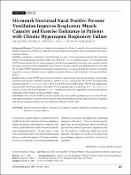
Loading...
Name
attachment.pdf
Size
184.72 KB
Format
Adobe PDF
Checksum
(MD5):80ed0e211405ff8de6cfdd3689843a8a
Loading...
Name
attachment2.pdf
Size
158.05 KB
Format
Adobe PDF
Checksum
(MD5):beed73f742d25b54c4cdc22221d8b203