Options
Clinical and biochemical presentations of polycystic ovary syndrome among obese and nonobese women.
Type
article
Resource
Fertil Steril.
Date Issued
2008
Author(s)
許淳森
Liou TH; Yang JH; Hsieh CH; Lee CY; Hsu CS; Hsu MI
Subjects
學科:婦產學科
期刊論文
Abstract
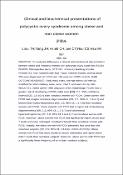
OBJECTIVE: To study the differences in clinical and biochemical characteristics between obese and nonobese women with polycystic ovary syndrome (PCOS).
DESIGN: Retrospective study.
SETTING: University teaching hospital.
PATIENT(S): Four hundred sixty-four Taiwan Chinese women, among whom 295 were diagnosed with PCOS and 169 were non-PCOS controls.
MAIN OUTCOME MEASURE(S): Body mass index, average menstrual interval, modified Ferriman-Gallwey score, acne, total T, and waist-to-hip ratio.
RESULT(S): Obese women with polycystic ovary morphology (PCOM) had a greater risk of developing of PCOS (odds ratio [OR], 2.5; 95% confidence interval [CI], 1.5-10.4) than nonobese women with PCOM. Obese women with PCOM had a higher incidence oligomenorrhea (OR, 2.6; 95% CI, 1.6-4.1) and biochemical hyperandrogenemia (OR, 2.5; 95% CI, 1.6-4.0) than nonobese women with PCOM. Obese subjects with PCOS had a higher risk of developing oligomenorrhea (OR, 2.2; 95% CI, 1.3-3.7) and biochemical hyperandrogenemia (OR, 2.6; 95% CI, 1.6-4.2) than nonobese women with PCOS. Moreover, obese women with PCOS had significantly higher serum total T levels and more prolonged menstrual intervals than nonobese women with PCOS. Notably, the obese women with PCOS presented less acne than the nonobese subjects (OR, 0.5; 95% CI, 0.3-0.9).
CONCLUSION(S): Obese women with PCOS had more severe ovulatory dysfunction and higher serum total T levels than nonobese subjects. Moreover, obese women with PCOS had a significantly lower frequency of acne than nonobese subjects
DESIGN: Retrospective study.
SETTING: University teaching hospital.
PATIENT(S): Four hundred sixty-four Taiwan Chinese women, among whom 295 were diagnosed with PCOS and 169 were non-PCOS controls.
MAIN OUTCOME MEASURE(S): Body mass index, average menstrual interval, modified Ferriman-Gallwey score, acne, total T, and waist-to-hip ratio.
RESULT(S): Obese women with polycystic ovary morphology (PCOM) had a greater risk of developing of PCOS (odds ratio [OR], 2.5; 95% confidence interval [CI], 1.5-10.4) than nonobese women with PCOM. Obese women with PCOM had a higher incidence oligomenorrhea (OR, 2.6; 95% CI, 1.6-4.1) and biochemical hyperandrogenemia (OR, 2.5; 95% CI, 1.6-4.0) than nonobese women with PCOM. Obese subjects with PCOS had a higher risk of developing oligomenorrhea (OR, 2.2; 95% CI, 1.3-3.7) and biochemical hyperandrogenemia (OR, 2.6; 95% CI, 1.6-4.2) than nonobese women with PCOS. Moreover, obese women with PCOS had significantly higher serum total T levels and more prolonged menstrual intervals than nonobese women with PCOS. Notably, the obese women with PCOS presented less acne than the nonobese subjects (OR, 0.5; 95% CI, 0.3-0.9).
CONCLUSION(S): Obese women with PCOS had more severe ovulatory dysfunction and higher serum total T levels than nonobese subjects. Moreover, obese women with PCOS had a significantly lower frequency of acne than nonobese subjects
File(s)
Loading...
Name
attachment.pdf
Size
365.77 KB
Format
Adobe PDF
Checksum
(MD5):07457ad231a093c3562f1b4cbb2691c6
Loading...
Name
attachment2.pdf
Size
33.71 KB
Format
Adobe PDF
Checksum
(MD5):87306e586d23356ae5ee1bf53a466df0