Options
Gene copy number variations in Asian patients with congenital bilateral absence of the vas deferens
Type
article
Resource
Human Reproduction.(24):748-755.
Date Issued
2009
Author(s)
吳建志
Lee CH; Wu CC; Wu YN; Chiang HS
Subjects
學科:泌尿學科
期刊論文
Abstract
background: Congenital bilateral absence of the vas deferens (CBAVD) is a distinct clinical entity accounting for 25% of obstructive
azoospermia in infertile men. The association between CBAVD and mutated CFTR (cystic fibrosis transmembrane conductance regulator)
alleles is well demonstrated in Caucasians, but the identity of CBAVD-susceptibility genes remains elusive in Asians. We investigate
genomic copy number variations (CNVs) in a patient cohort of Taiwan.
methods and results: Genome-wide screening for genetic CNVs was conducted on eight individuals with CBAVD using arraybased
comparative genomic hybridization. One recurrent CNV was detected on 3q26.1 in five patients, and another was detected on a
reproduction-related gene PANK2 in two patients. For the former, we further characterized the breakpoints in CBAVD and assessed the
incidence in healthy individuals by tiling path arrays. The deletion in each patient was confirmed, and seven out of the eight controls
were also affected. Examination of the homozygous loss of PANK2 by PCR in a larger cohort showed a homozygous deletion in only one
of the 26 CBAVD males, and not in any of the 20 azoospermic patients without CBAVD, nor in any of the 16 control subjects.
conclusions: Our results suggest that 3q26.1 may not be a critical region for CBAVD. Additionally no strong association was found for
PANK2 in this reproduction disorder. Other reproduction-related genes, such as PBX1, BRD3, COL18A1 and HMOX1, identified by this initial
study may inspire further investigation.
azoospermia in infertile men. The association between CBAVD and mutated CFTR (cystic fibrosis transmembrane conductance regulator)
alleles is well demonstrated in Caucasians, but the identity of CBAVD-susceptibility genes remains elusive in Asians. We investigate
genomic copy number variations (CNVs) in a patient cohort of Taiwan.
methods and results: Genome-wide screening for genetic CNVs was conducted on eight individuals with CBAVD using arraybased
comparative genomic hybridization. One recurrent CNV was detected on 3q26.1 in five patients, and another was detected on a
reproduction-related gene PANK2 in two patients. For the former, we further characterized the breakpoints in CBAVD and assessed the
incidence in healthy individuals by tiling path arrays. The deletion in each patient was confirmed, and seven out of the eight controls
were also affected. Examination of the homozygous loss of PANK2 by PCR in a larger cohort showed a homozygous deletion in only one
of the 26 CBAVD males, and not in any of the 20 azoospermic patients without CBAVD, nor in any of the 16 control subjects.
conclusions: Our results suggest that 3q26.1 may not be a critical region for CBAVD. Additionally no strong association was found for
PANK2 in this reproduction disorder. Other reproduction-related genes, such as PBX1, BRD3, COL18A1 and HMOX1, identified by this initial
study may inspire further investigation.
File(s)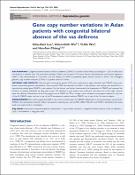
Loading...
Name
attachment.pdf
Size
376.83 KB
Format
Adobe PDF
Checksum
(MD5):6ca3c200615249c4d14c5d1a88db34de
Loading...
Name
attachment2.pdf
Size
42.34 KB
Format
Adobe PDF
Checksum
(MD5):047c8df556ac07bbea1738f027e69018