Options
Taiwanese native plants inhibit matrix metalloproteinase-9 activity after ultraviolet B irradiation
Type
article
Resource
Molecules.(14):1062-1071.
Date Issued
2009
Author(s)
呂思潔
Lee YL; Lee MH; Chang HJ; Huang PY; Huang IJ; Chrng KT; Leu SJ
Subjects
學科:微生物免疫學科
期刊論文
Abstract
Medicinal plants have long been used as a source of therapeutic agents. They are thought to be important anti-aging ingredients in prophylactic medicines. The aim of this study was to screen extracts from Taiwanese plant materials for phenolic contents and measure the corresponding matrix metalloproteinase-9 (MMP-9) activity. We extracted biological ingredients from eight plants native to Taiwan (Alnus formosana, Diospyros discolor, Eriobotrya deflex, Machilus japonica, Pyrrosia polydactylis, Pyrus taiwanensis, Vitis adstricta, Vitis thunbergii). Total phenolic content was measured using the Folin-Ciocalteu method. MMP-9 activities were measured by gelatin zymography. The extracted yields of plants ranged from 3.7 % to 16.9 %. The total phenolic contents ranged from 25.4 to 36.8 mg GAE/g dry material. All of these extracts (except Vitis adstricta Hance) were shown to inhibit MMP-9 activity of WS-1 cell after ultraviolet B irradiation. These findings suggest that total phenolic content may influence MMP-9 activity and that some of the plants with higher phenolic content exhibited various biological activities that could serve as potent inhibitors of the ageing process in the skin. This property might be useful in the production of cosmetics.
File(s)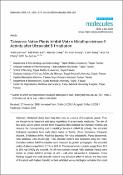
Loading...
Name
attachment.pdf
Size
238.19 KB
Format
Adobe PDF
Checksum
(MD5):7e3cfeb64567e446e1102f264ff58ee4
Loading...
Name
attachment2.pdf
Size
39.35 KB
Format
Adobe PDF
Checksum
(MD5):98dbaaa1075450abd3fe25945a82de31