Options
Gastrointestinal Quality of Life Following Laparoscopic Adjustable Gastric Banding in Asia
Type
article
Resource
Obesity Surgery.(16):586-591.
Date Issued
2006
Subjects
外科學科
期刊論文
Abstract
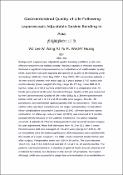
BACKGROUND: Laparoscopic adjustable gastric banding (LAGB) is a safe and effective treatment for morbid obesity. Previous studies in Western countries disclosed a significant improvement in co-morbidities and health-related quality of life. Data from Asia and regarding the specific GI quality of life following LAGB are lacking.
METHODS: From May 2002 to May 2005, 107 consecutive patients - 48 men and 59 women, with mean age 31.4 years (range 17-57 years) with morbid obesity (mean weight 115.8 kg, range 81-174 kg; mean BMI 41.3 kg/m(2), range 32.0-59.8 kg/m(2)) underwent LAGB in a prospective trial. All bands were placed via the pars flaccida technique. Quality of life was measured by the Gastrointestinal Quality of Life Index (GIQLI), a 36item questionnaire before LAGB, and at 3, 6, 12 and 24 months after surgery.
RESULTS: All procedures were performed laparoscopically with no conversions. There was neither intra-operative complications nor major postoperative complications. Minor complications occurred in 3 patients (2.8%); all were transient stoma obstruction. At follow-up, only one band (0.94%) was removed at 3 months postoperatively because of the patient's intolerance. No gastric slippage occurred. 4 patients (3.7%) had tubing problems and required revision surgery for port adjustment. Mean BMI decreased from 41.3 to 33.1 after 2 years. Percent excess BMI loss averaged 48.1% at 2 years (range 6.7-139.2). All co-morbidities were eliminated significantly. 80% of patients were satisfied with the results at 2 years. However, the GIQLI score remained similar before and after surgery. Preoperative score was 110.8+15 points. The score became 116.2+13, 114.7+13, 108.5+14 and 107.2+17 at 3, 6, 12 and 24 months. The patients had improvement in 3 domains of general health (social, physical and emotional functions), but decrease in the domain of symptoms.
CONCLUSION: Although LAGB was successful in weight loss and resolution of co-morbidities in morbidly obese patients, the GIQLI did not improve. This feature will be the major disadvantage of LAGB.
METHODS: From May 2002 to May 2005, 107 consecutive patients - 48 men and 59 women, with mean age 31.4 years (range 17-57 years) with morbid obesity (mean weight 115.8 kg, range 81-174 kg; mean BMI 41.3 kg/m(2), range 32.0-59.8 kg/m(2)) underwent LAGB in a prospective trial. All bands were placed via the pars flaccida technique. Quality of life was measured by the Gastrointestinal Quality of Life Index (GIQLI), a 36item questionnaire before LAGB, and at 3, 6, 12 and 24 months after surgery.
RESULTS: All procedures were performed laparoscopically with no conversions. There was neither intra-operative complications nor major postoperative complications. Minor complications occurred in 3 patients (2.8%); all were transient stoma obstruction. At follow-up, only one band (0.94%) was removed at 3 months postoperatively because of the patient's intolerance. No gastric slippage occurred. 4 patients (3.7%) had tubing problems and required revision surgery for port adjustment. Mean BMI decreased from 41.3 to 33.1 after 2 years. Percent excess BMI loss averaged 48.1% at 2 years (range 6.7-139.2). All co-morbidities were eliminated significantly. 80% of patients were satisfied with the results at 2 years. However, the GIQLI score remained similar before and after surgery. Preoperative score was 110.8+15 points. The score became 116.2+13, 114.7+13, 108.5+14 and 107.2+17 at 3, 6, 12 and 24 months. The patients had improvement in 3 domains of general health (social, physical and emotional functions), but decrease in the domain of symptoms.
CONCLUSION: Although LAGB was successful in weight loss and resolution of co-morbidities in morbidly obese patients, the GIQLI did not improve. This feature will be the major disadvantage of LAGB.
File(s)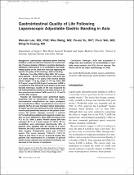
Loading...
Name
attachment.pdf
Size
93.12 KB
Format
Adobe PDF
Checksum
(MD5):9332c64b0516b1facb633f8cae054a3e
Loading...
Name
attachment2.pdf
Size
36.77 KB
Format
Adobe PDF
Checksum
(MD5):fe37364a0b65525852aa6a8963c1f71f