Options
Effect of purple sweet potato leaves consumption on the modulation of the antioxidative status in basketball players during training
Type
article
Resource
Asia Pacific J Clin Nutr.(16):456-462
Date Issued
2007
Author(s)
Chang WS
Chen CM
Hu SP
Kan NW
Chiu CC
Liu JF
Subjects
保健營養學系
期刊論文
Abstract
The aim of this study was to evaluate the effect of purple sweet potato leaves (PSPLs) consumption on antioxidative status and its modulation of that status in basketball players during training period. Fifteen elite basketball players were enrolled in this study. The seven-week study consisted of a run-in (week 1), PSPLs diet (daily consumption of 200 g PSPLs) (weeks 2, 3), washout (weeks 4, 5), and control diet (low polyphenol, with the amount of carotenoids adjusted to the same level as that of PSPLs) (weeks 6, 7). Blood and urine samples were taken for biochemical analysis. Compared with the control group, the results showed that PSPLs consumption led to a significant increase of plasma polyphenol concentration and vitamin E and C levels. Low density lipoprotein (LDL) lag time was significantly longer in the PSPLs group. A significant decrease of urinary 8-hydroxy-2-
deoxyguanosine (8-OHdG) was noted; however, there was no significant change in plasma glutathione (GSH), total antioxidant status (TAS) and malondialdehyde + 4-hydroxy-2(E)-nonenal level after consuming the PSPLs diet. In conclusion, consumption of PSPLs diet for 2 weeks may reduce lipid and DNA oxidation that can modulate the antioxidative status of basketball players during training period.
deoxyguanosine (8-OHdG) was noted; however, there was no significant change in plasma glutathione (GSH), total antioxidant status (TAS) and malondialdehyde + 4-hydroxy-2(E)-nonenal level after consuming the PSPLs diet. In conclusion, consumption of PSPLs diet for 2 weeks may reduce lipid and DNA oxidation that can modulate the antioxidative status of basketball players during training period.
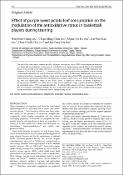
The aim of this study was to evaluate the effect of purple sweet potato leaves (PSPLs) consumption on antioxidative status and its modulation of that status in basketball players during training period. Fifteen elite basketball players were enrolled in this study. The seven-week study consisted of a run-in (week 1), PSPLs diet (daily consumption of 200 g PSPLs) (weeks 2, 3), washout (weeks 4, 5), and control diet (low polyphenol, with the amount of carotenoids adjusted to the same level as that of PSPLs) (weeks 6, 7). Blood and urine samples were taken for biochemical analysis. Compared with the control group, the results showed that PSPLs consumption led to a significant increase of plasma polyphenol concentration and vitamin E and C levels. Low density lipoprotein (LDL) lag time was significantly longer in the PSPLs group. A significant decrease of urinary 8-hydroxy-2-
deoxyguanosine (8-OHdG) was noted; however, there was no significant change in plasma glutathione (GSH), total antioxidant status (TAS) and malondialdehyde + 4-hydroxy-2(E)-nonenal level after consuming the PSPLs diet. In conclusion, consumption of PSPLs diet for 2 weeks may reduce lipid and DNA oxidation that can modulate the antioxidative status of basketball players during training period.
deoxyguanosine (8-OHdG) was noted; however, there was no significant change in plasma glutathione (GSH), total antioxidant status (TAS) and malondialdehyde + 4-hydroxy-2(E)-nonenal level after consuming the PSPLs diet. In conclusion, consumption of PSPLs diet for 2 weeks may reduce lipid and DNA oxidation that can modulate the antioxidative status of basketball players during training period.
File(s)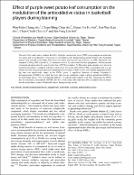
Loading...
Name
attachment.pdf
Size
208.13 KB
Format
Adobe PDF
Checksum
(MD5):a688247c84faa17976a822319a44529b
Loading...
Name
attachment2.pdf
Size
207.56 KB
Format
Adobe PDF
Checksum
(MD5):7f322955c7de777f7670e7a608046dfe