Options
Byakangelicol, isolated from Angelica dahurica, inhibits both the activity and induction of cyclooxygenase-2 in human pulmonary epithelial cells
Type
article
Resource
J. Pharmacy and Pharmacology.(54):1271-1278.
Date Issued
2002
Author(s)
王靜瓊; 楊玲玲
Lin CH; Chang CC; Wang CC; Chang MS; Yang LL
Subjects
藥學系
期刊論文
Abstract
We examined the inhibitory mechanism of byakangelicol, isolated from Angelica dahurica, on interleukin-1beta (IL-1beta)-induced cyclooxygenase-2 (COX-2) expression and prostaglandin E2 (PGE2) release in human pulmonary epithelial cell line (A549). Byakangelicol (10-50 microM) concentration-dependently attenuated IL-1beta-induced COX-2 expression and PGE2 release. The selective COX-2 inhibitor, NS-398 (0.01-1 microM), and byakangelicol (10-50 microM) both concentration-dependently inhibited the activity of the COX-2 enzyme. Byakangelicol, at a concentration up to 200 microM, did not affect the activity and expression of COX-1 enzyme. IL-1beta-induced p44/42 mitogen-activated protein kinase (MAPK) activation was inhibited by the MAPK/extracellular signal-regulated protein kinase (MEK) inhibitor, PD 98059 (30 microM), while byakangelicol (50 microM) had no effect. Treatment of cells with byakangelicol (50 microM) or pyrrolidine dithiocarbamate (PDTC; 50 microM) partially inhibited IL-1beta-induced degradation of IkappaB-alpha in the cytosol, translocation of p65 NF-kappaB from the cytosol to the nucleus and the NF-kappaB-specific DNA-protein complex formation. Taken together, we have demonstrated that byakangelicol inhibits IL-1beta-induced PGE2 release in A549 cells; this inhibition may be mediated by suppression of COX-2 expression and the activity of COX-2 enzyme. The inhibitory mechanism of byakangelicol on IL-1beta-induced COX-2 expression may be, at least in part, through suppression of NF-kappaB activity. Therefore, byakangelicol may have therapeutic potential as an anti-inflammatory drug on airway inflammation.
File(s)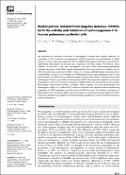
Loading...
Name
attachment.pdf
Size
403.61 KB
Format
Adobe PDF
Checksum
(MD5):38e348fc9af4a6a312927ca2c9061520
Loading...
Name
attachment2.pdf
Size
35.73 KB
Format
Adobe PDF
Checksum
(MD5):23c18a55fce31d81cf7a2ab2001d0fdd