Options
Effects of epidermal growth factor and linoleic acid on lipid contents in human intestinal C2BBe1 cells
Type
article
Resource
IUBMB LIfe.(54):275-279.
Date Issued
2002
Author(s)
趙振瑞
Liang C-F; Chao JC-J; Hwang S-M and Tsai Y-H
Subjects
保健營養學系
期刊論文
Abstract
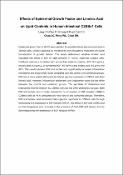
Epidermal growth factor (EGF) was reported to regulate triacyl glycerol synthesis in various cells. Linoleic acid and its metabolites were thought to modulate the signal transduction of growth factors. This study determined whether linoleic acid regulated the effect of EGF on lipid contents in human intestinal C2BBe1 cells. Confluent cells were incubated with serum-free medium (control), EGF (45 ng/mL), linoleic acid (42 microg/mL), or combined EGF (45 ng/mL) and linoleic acid (42 microg/mL) for 48 h. The results showed EGF and linoleic acid significantly increased intracellular cholesterol and triglyceride levels compared with the control and combined groups. EGF was a more potent stimulator for triacyl glycerol synthesis in C2BBe1 cells than linoleic acid. However, intracellular cholesterol and triglyceride levels did not differ between the control and combined groups. The secretion of cholesterol and triglyceride into the medium by C2BBe1 cells did not differ among four groups. Both EGF and linoleic acid strongly stimulated the expression of EGF receptor mRNA in C2BBe1 cells at 48 h compared with the control and combined groups. Therefore, EGF and linoleic acid increased triacyl glycerol synthesis in C2BBe1 cells through stimulating the expression of EGF receptor mRNA. The effect of EGF and linoleic acid on this lipogenesis was reversed in the presence of both EGF and linoleic acid by downregulating the expression of EGF receptor mRNA.
File(s)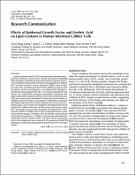
Loading...
Name
attachment.pdf
Size
135.91 KB
Format
Adobe PDF
Checksum
(MD5):79fb2386ad37665e66343f26d2bd4026
Loading...
Name
attachment2.pdf
Size
449.11 KB
Format
Adobe PDF
Checksum
(MD5):b8338290b1408bd05dd06ec234395dd5