Options
The Effect of Ankle Position on Pelvic Floor Muscle Contraction Activity in Women (accepted article)
Type
article
Resource
Journal of Urology.(181):1217-1223.
Date Issued
2009
Author(s)
陳品玲
Chen HL; Lin YC; Jen CW; Huang WC; Lin HY; Chen PL
Subjects
學士後護理學系
期刊論文
Abstract
Purpose
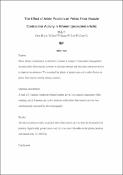
Stress urinary incontinence is extremely common in women. Conservative management includes pelvic floor muscle exercises to increase strength and muscular contraction forces to improve incontinence. We examined the effects of passive and active ankle flexion on pelvic floor muscle activity during exercises.
Materials and Methods
A total of 31 married women performed random pelvic floor muscle contractions while standing, and in 8 passive and active positions while pelvic floor muscle activity was simultaneously measured by electromyography.
Results
All ankle positions resulted in greater pelvic floor muscle activity than the horizontal foot position. Significantly greater muscle activity was seen with ankles in the plantar position with raised arms (p = 0.0051).
Conclusions
Pelvic floor muscle exercises performed with active ankle positions may increase the effectiveness of these exercises. Further studies are required to elucidate mechanisms for this finding.
Key Words: urinary incontinence; stress; muscle; skeletal; ankle joint; pelvic floor; electromyography
Abbreviations: DF, dorsiflexion; DFAU, DF and arms up; EMG, electromyography; HS, horizontal standing; MVC, maximal voluntary contraction; PF, plantar flexion; PFAU, PF and arms up; PFM, pelvic floor muscle; SUI, stress urinary incontinence
Stress urinary incontinence is extremely common in women. Conservative management includes pelvic floor muscle exercises to increase strength and muscular contraction forces to improve incontinence. We examined the effects of passive and active ankle flexion on pelvic floor muscle activity during exercises.
Materials and Methods
A total of 31 married women performed random pelvic floor muscle contractions while standing, and in 8 passive and active positions while pelvic floor muscle activity was simultaneously measured by electromyography.
Results
All ankle positions resulted in greater pelvic floor muscle activity than the horizontal foot position. Significantly greater muscle activity was seen with ankles in the plantar position with raised arms (p = 0.0051).
Conclusions
Pelvic floor muscle exercises performed with active ankle positions may increase the effectiveness of these exercises. Further studies are required to elucidate mechanisms for this finding.
Key Words: urinary incontinence; stress; muscle; skeletal; ankle joint; pelvic floor; electromyography
Abbreviations: DF, dorsiflexion; DFAU, DF and arms up; EMG, electromyography; HS, horizontal standing; MVC, maximal voluntary contraction; PF, plantar flexion; PFAU, PF and arms up; PFM, pelvic floor muscle; SUI, stress urinary incontinence
File(s)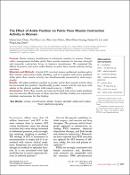
Loading...
Name
attachment.pdf
Size
697.4 KB
Format
Adobe PDF
Checksum
(MD5):2c69bc56a6ad4f646c7b8bc2e11159a1
Loading...
Name
attachment2.pdf
Size
48.85 KB
Format
Adobe PDF
Checksum
(MD5):cb3c22a732da43f1454df73383e50ead