Options
Interfacial reactions and electrical properties of hafnium-based thin films in Cu/barrier/n+-p junction diodes
Type
article
Resource
MICROELECTRONIC ENGINEERING.(77):184-192.
Date Issued
2005
Author(s)
歐耿良
Ou KL; Tsai MH; Huang HM; Chiou SY; Lin CT; Lee SY
Subjects
生醫材料暨組織工程研究所
期刊論文
Abstract
In this study, the barrier properties of Hf and nitrogen incorporated Hf films were investigated by Cu/Hf–N/Si structure. Hafnium and hafnium nitride films were prepared by reactive rf-magnetron sputtering on blank silicon wafers. The barrier properties were evaluated by sheet resistance, X-ray diffraction, transmission electron microscopy, scanning electron microscopy, and X-ray photoelectron spectroscopy. The as-deposited Hf film has a hexagonal close packed structure and a low resistivity of 100.98 μΩ-cm. With increasing nitrogen concentration of Hf–N film, phase transformations are identified as hcp-Hf → fcc-HfN. The thermal stability of Cu/Hf/Si and Cu/HfN0.47/Si contact system is evaluated by thermal stressing at various annealing temperatures. Nitrogen incorporated Hf films possess better barrier performance than sputtered Hf films. For the Cu/Hf/Si contact system, the interfacial reaction between the Hf barrier layer and the Cu layer is observed after annealing at 550 °C for 30 min, and copper–hafnium compounds form. Highly resistive copper silicide forms after annealing at 600 °C for 30 min. The Hf barrier fails due to the reaction of Cu and the Hf barrier, in which Cu atoms penetrate into the Si substrate after annealing at high temperature. The Cu/HfN0.47/Si is fairly stable up to annealing at 650 °C for 30 min. In addition, no copper–hafnium and copper silicide compounds are found. Diffusion resistance of nitrogen-incorporated Hf barrier is more effective. The thermal stabilities of Cu/HfN0.47/n+–p junction diodes are enhanced by nitrogen incorporation. The Cu/Hf/n+–p junction diodes result in large reverse-biased junction leakage currents after annealing at 500 °C for 30 min. On the other hand, Nitrogen incorporated Hf diffusion barriers retained the integrity of junction diodes up to 550 °C with lower reverse current densities. Phase transformation of hafnium-based barrier films with nitrogen incorporation are believed to impede Cu diffusion into the Si substrate and hence improve the barrier performance. Nitrogen incorporated hafnium diffusion barrier can suppress the formation of copper–hafnium compounds and copper penetration, and thus improve the thermal stability of barrier layer.
File(s)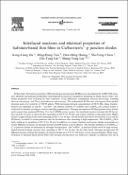
Loading...
Name
attachment.pdf
Size
464.04 KB
Format
Adobe PDF
Checksum
(MD5):bafda8eee0435cf77f838ff83a17a689
Loading...
Name
attachment2.pdf
Size
64.96 KB
Format
Adobe PDF
Checksum
(MD5):9613dbc7e9d59802321b53aa9dae0987