Options
Micronutrients and lifestyles in Taiwanese patients with stage 3 to 5
Type
article
Resource
Nutrition (In Press)
Date Issued
2009
Author(s)
薛玉梅
Chiang SS; Tai CW; Chung CJ; Shiue HS; Chen JB; Su CT; Hsueh YM
Subjects
公共衛生學科
期刊論文
Abstract
OBJECTIVE: Lycopene is an antioxidant that reduces oxidative stress. Analgesics are commonly used and may impair kidney function. However, the associations among plasma lycopene, analgesic use, and chronic kidney disease (CKD) are unknown. A hospital-based, case-control study was conducted to determine the association among plasma lycopene, analgesic use, and CKD.
METHODS: Two hundred one patients with CKD and 313 controls were recruited, and CKD was defined as an estimated glomerular filtration rate <60 mL/min per 1.73 m(2), as calculated by the Modification of Diet in Renal Disease formula. Plasma antioxidants were measured by high-performance liquid chromatography.
RESULTS: This study showed that the higher the plasma lycopene was, the lower the CKD risk. Specifically, in subjects with a plasma lycopene level >or=17.97 or 7.72-17.97 microg/dL, the adjusted odds ratio of CKD was 0.32 (95% confidence interval 0.18-0.58) or 0.49 (95% confidence interval 0.29-0.83), respectively, compared with subjects with a plasma lycopene level <7.72 microg/dL, independent of age, gender, level of education, paternal and maternal ethnicities, cigarette smoking, analgesic use, hypertension, and diabetes history. In contrast, the higher the plasma retinol level, the higher the risk of CKD. A significantly higher risk was demonstrated in analgesic users than in non-users (odds ratio 3.83, 95% confidence interval 1.75-8.40), but a significantly lower risk was shown in subjects who used analgesics on an as-needed basis than in non-users. Plasma lycopene tended to interact additively with analgesic consumption in modifying the CKD risk; however, the interactions were statistically insignificant.
CONCLUSION: This is the first study showing that a low plasma lycopene level is associated with CKD risk
METHODS: Two hundred one patients with CKD and 313 controls were recruited, and CKD was defined as an estimated glomerular filtration rate <60 mL/min per 1.73 m(2), as calculated by the Modification of Diet in Renal Disease formula. Plasma antioxidants were measured by high-performance liquid chromatography.
RESULTS: This study showed that the higher the plasma lycopene was, the lower the CKD risk. Specifically, in subjects with a plasma lycopene level >or=17.97 or 7.72-17.97 microg/dL, the adjusted odds ratio of CKD was 0.32 (95% confidence interval 0.18-0.58) or 0.49 (95% confidence interval 0.29-0.83), respectively, compared with subjects with a plasma lycopene level <7.72 microg/dL, independent of age, gender, level of education, paternal and maternal ethnicities, cigarette smoking, analgesic use, hypertension, and diabetes history. In contrast, the higher the plasma retinol level, the higher the risk of CKD. A significantly higher risk was demonstrated in analgesic users than in non-users (odds ratio 3.83, 95% confidence interval 1.75-8.40), but a significantly lower risk was shown in subjects who used analgesics on an as-needed basis than in non-users. Plasma lycopene tended to interact additively with analgesic consumption in modifying the CKD risk; however, the interactions were statistically insignificant.
CONCLUSION: This is the first study showing that a low plasma lycopene level is associated with CKD risk
File(s)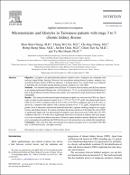
Loading...
Name
attachment.pdf
Size
416.83 KB
Format
Adobe PDF
Checksum
(MD5):845aff17db23b90f2f2b3a17ed291873
Loading...
Name
attachment2.pdf
Size
113.63 KB
Format
Adobe PDF
Checksum
(MD5):e2dab15194dbb90058b6c0a58afb5371