Options
Association between survivin promoter -31C/G polymorphism and urothelial carcinoma risk in Taiwanese population.
Type
article
Resource
Urology.(73):670-674.
Date Issued
2009
Author(s)
Wang YH; Chiou HY; Lin CT; Hsieh HY; Wu CC; Hsu CD; Shen CH
Subjects
公共衛生學系
期刊論文
Abstract
Objectives
To investigate the association between survivin gene promoter −31 C/G polymorphism and urothelial carcinoma (UC) risk in a Taiwanese population.
Methods
A total of 190 patients with pathologically confirmed UC and 210 unrelated controls without cancer were recruited at Chiayi Christian Hospital from August 2002 to May 2007. The −31 C/G polymorphism in the survivin gene promoter was determined using polymerase chain reaction-restriction fragment length polymorphism analysis.
Results
Compared with study subjects carrying the G/G genotype, significantly increased UC risks were found for individuals carrying the C/G genotype (odds ratio 2.8; 95% confidence interval [CI] 1.7-4.6) and those with the C/C genotype (odds ratio 4.0; 95% CI 2.3-7.2). Those carrying the C/C or C/G genotype had a significantly increased UC risk of 3.2 (95% CI 1.9-5.2) compared with those with the G/G genotype. Among heavy smokers (≥30 pack-years), we found a significantly increased UC risk of 3.8 (95% CI 1.3-11.3) for individuals with the C/C or C/G genotype compared with those with the G/G genotype. Furthermore, patients with UC carrying the C/C genotype had a significantly greater prevalence of muscle-invasive (Stage T2-T4), high-grade (G3), or invasive, high-grade tumor compared with those carrying the G/G genotype.
Conclusions
These findings suggest that the −31 C/G polymorphism of the survivin gene promoter is associated with both the clinical tumor stage and the pathologic tumor grade and might be involved in the development of UC.
To investigate the association between survivin gene promoter −31 C/G polymorphism and urothelial carcinoma (UC) risk in a Taiwanese population.
Methods
A total of 190 patients with pathologically confirmed UC and 210 unrelated controls without cancer were recruited at Chiayi Christian Hospital from August 2002 to May 2007. The −31 C/G polymorphism in the survivin gene promoter was determined using polymerase chain reaction-restriction fragment length polymorphism analysis.
Results
Compared with study subjects carrying the G/G genotype, significantly increased UC risks were found for individuals carrying the C/G genotype (odds ratio 2.8; 95% confidence interval [CI] 1.7-4.6) and those with the C/C genotype (odds ratio 4.0; 95% CI 2.3-7.2). Those carrying the C/C or C/G genotype had a significantly increased UC risk of 3.2 (95% CI 1.9-5.2) compared with those with the G/G genotype. Among heavy smokers (≥30 pack-years), we found a significantly increased UC risk of 3.8 (95% CI 1.3-11.3) for individuals with the C/C or C/G genotype compared with those with the G/G genotype. Furthermore, patients with UC carrying the C/C genotype had a significantly greater prevalence of muscle-invasive (Stage T2-T4), high-grade (G3), or invasive, high-grade tumor compared with those carrying the G/G genotype.
Conclusions
These findings suggest that the −31 C/G polymorphism of the survivin gene promoter is associated with both the clinical tumor stage and the pathologic tumor grade and might be involved in the development of UC.
File(s)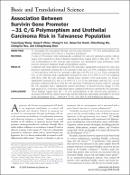
Loading...
Name
attachment.pdf
Size
102.85 KB
Format
Adobe PDF
Checksum
(MD5):559594cadcc19744ea63d2abe6ff3797