Options
Mechanisms of resveratrol-induced platelet apoptosis
Type
article
Resource
Cardiovascular Research.(83):575-585.
Date Issued
2009
Author(s)
Lin KH; Hsiao George; Shih CM; Chou DS; Sheu JR;
Subjects
學科:生物化學暨細胞分子生物學科
期刊論文
Abstract
AIMS: Apoptotic events have recently been found to occur in platelets, which are anuclear. Resveratrol is present in red wine and has various biological activities, including inhibition of platelet aggregation. Although considerable evidence is available as to the induction of tumour cell apoptosis by resveratrol, resveratrol's effects on platelet apoptosis have not yet been investigated. In the present study, we demonstrate that resveratrol also markedly stimulates apoptosis in washed human platelets.
METHODS AND RESULTS: Resveratrol (5-25 microM) completely inhibited platelet aggregation stimulated by collagen. Furthermore, resveratrol time- and concentration-dependently stimulated dissipation of the mitochondrial membrane potential (DeltaPsim), activation of caspases-9, -3, and -8, gelsolin and actin cleavage, Bid cleavage into truncated Bid, Bax translocation, cytochrome c release, and phosphatidylserine exposure but not P-selectin expression in washed human platelets. The presence of z-IETD-fmk, a caspase-8 inhibitor, markedly reversed tBid formation and caspase activation and partially reversed the dissipation of platelet DeltaPsim stimulated by resveratrol. In addition, resveratrol also directly evoked dissipation of DeltaPsim and release of cytochrome c from isolated mitochondria. Furthermore, resveratrol shortened platelet survival or enhanced platelet clearance in an in vivo study.
CONCLUSION: This study demonstrates for the first time that resveratrol simultaneously inhibits platelet aggregation and stimulates platelet apoptosis. Stimulation of platelet apoptosis by resveratrol may represent the increased therapeutic potential for patients suffering from thrombotic conditions or thrombocytosis to promote platelet destruction and thus prevent pathological clotting. Furthermore, this study also provides a novel conception that rigorous surveillance of platelet numbers may be important during resveratrol treatment in the clinic.
METHODS AND RESULTS: Resveratrol (5-25 microM) completely inhibited platelet aggregation stimulated by collagen. Furthermore, resveratrol time- and concentration-dependently stimulated dissipation of the mitochondrial membrane potential (DeltaPsim), activation of caspases-9, -3, and -8, gelsolin and actin cleavage, Bid cleavage into truncated Bid, Bax translocation, cytochrome c release, and phosphatidylserine exposure but not P-selectin expression in washed human platelets. The presence of z-IETD-fmk, a caspase-8 inhibitor, markedly reversed tBid formation and caspase activation and partially reversed the dissipation of platelet DeltaPsim stimulated by resveratrol. In addition, resveratrol also directly evoked dissipation of DeltaPsim and release of cytochrome c from isolated mitochondria. Furthermore, resveratrol shortened platelet survival or enhanced platelet clearance in an in vivo study.
CONCLUSION: This study demonstrates for the first time that resveratrol simultaneously inhibits platelet aggregation and stimulates platelet apoptosis. Stimulation of platelet apoptosis by resveratrol may represent the increased therapeutic potential for patients suffering from thrombotic conditions or thrombocytosis to promote platelet destruction and thus prevent pathological clotting. Furthermore, this study also provides a novel conception that rigorous surveillance of platelet numbers may be important during resveratrol treatment in the clinic.
File(s)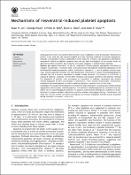
Loading...
Name
attachment.pdf
Size
671.27 KB
Format
Adobe PDF
Checksum
(MD5):4fd624683f12b3a1411853a06328a52a
Loading...
Name
attachment2.pdf
Size
39.1 KB
Format
Adobe PDF
Checksum
(MD5):8b59e2b74c0bdac4a720a095cdd48708