Options
Evaluation of the Effect of a Life Review Group Program on Self-Esteem and Life Satisfaction in the Elderly
Type
article
Resource
International Journal of Geriatric Psychiatry.(23):7-10.
Date Issued
2008
Author(s)
Chiang KJ; Lu RB; Chu H; Chang YC; Chou KR;
Subjects
學士後護理學系
期刊論文
Abstract
OBJECTIVE: This study was aimed at evaluating whether a Life Review Group Program (LRGP) improved the self-esteem and life satisfaction in the elderly.
METHODS: This randomized, controlled trial consisted of 75 elderly males from a Veterans' Home in Northern Taiwan, 36 of whom were in the experimental group and 39 of whom were in the control group. The subjects in the experimental group participated in an 8-week LRGP. Data were collected before and after the LRGP and again 1 month after the end of the program.
RESULTS: The study subjects had a mean age of 78.13 years. The generalized estimating equation was used to compare alterations in the self-esteem and life satisfaction of the elderly before and after the intervention. The alterations in self-esteem and life satisfaction in the experimental group after the LRGP were significantly improved compared to the control group. One month after the LRGP was completed, the self-esteem and life satisfaction of the experimental group continued to improve when compared with pre-intervention levels.
CONCLUSIONS: Based on these results, the LRGP can potentially improve the self-affirmation, confidence, and self-esteem of the elderly and promote short-term life satisfaction. The results of this study provide a model for clinical evidence-based therapy, serving as a reference for related studies and evaluation of health-promoting programs, as well as improving the health and quality of care of the elderly.
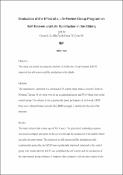
METHODS: This randomized, controlled trial consisted of 75 elderly males from a Veterans' Home in Northern Taiwan, 36 of whom were in the experimental group and 39 of whom were in the control group. The subjects in the experimental group participated in an 8-week LRGP. Data were collected before and after the LRGP and again 1 month after the end of the program.
RESULTS: The study subjects had a mean age of 78.13 years. The generalized estimating equation was used to compare alterations in the self-esteem and life satisfaction of the elderly before and after the intervention. The alterations in self-esteem and life satisfaction in the experimental group after the LRGP were significantly improved compared to the control group. One month after the LRGP was completed, the self-esteem and life satisfaction of the experimental group continued to improve when compared with pre-intervention levels.
CONCLUSIONS: Based on these results, the LRGP can potentially improve the self-affirmation, confidence, and self-esteem of the elderly and promote short-term life satisfaction. The results of this study provide a model for clinical evidence-based therapy, serving as a reference for related studies and evaluation of health-promoting programs, as well as improving the health and quality of care of the elderly.
File(s)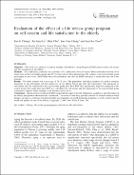
Loading...
Name
attachment.pdf
Size
81.98 KB
Format
Adobe PDF
Checksum
(MD5):2ef285eb9bbce5a91789283405c65fb0
Loading...
Name
attachment2.pdf
Size
50.42 KB
Format
Adobe PDF
Checksum
(MD5):c4a4a44e14de57f8be592ff6130ab28e