Options
Functional Modulation of Mitochondria by Eicosapentaenoic Acid Provides Protection against Ceramide Toxicity to C6 Glioma Cells
Type
article
Date Issued
2009
Author(s)
JAAN-YEH JENG;WEI-HWA LEE;YA-HUI TSAI;
Subjects
保健營養學系
期刊論文
Abstract
Mitochondrial dysfunction and associated apoptosis have been reported in the pathogenesis of neuron degeneration. The effects of eicosapentaenoic acid (EPA) and arachidonic acid (AA) on the mitochondrial membrane potential, mitochondrial biogenesis, and mitochondrial function of rat C6 glioma cells were determined in this study. Increased cytochrome c release and activated caspase-3 expression were determined in cells treated with >20 microM C(2) ceramide. There were significant repressive effects on ceramide-induced cell death with 25-100 microM EPA and 25 microM AA pretreatment. However, significantly increased membrane potentials were detected in cells pretreated with 25 and 50 microM EPA compared to ceramide-treated cells, but not in AA pretreatment groups. In cells pretreated with EPA, ATP production loss was prevented from ceramide-induced mitochondrial dysfunction. In mitochondrial biogenesis related assay, both EPA and AA enhanced peroxisome proliferator-activated receptor gamma-coactivator-1alpha (PGC-1alpha) and mitochondrial transcription factor A (Tfam) transcriptional activities. However, elevated PGC-1alpha transcriptional activities in groups pretreated with 25, 50, and 100 microM EPA and only in the 100 microM AA group were analyzed. The Tfam transcriptional activities were enhanced in groups pretreated with 25 and 50 microM EPA and AA. Increased NADH dehydrogenase subunit 6 (ND6) mRNA expression was determined in cells pretreated with 25 and 50 microM EPA and 25 microM AA. Elevated protein levels of Tfam, flavoprotein, and cytochrome oxidase subunit III (COX III) were determined in cells pretreated with 25 and 50 microM EPA. The EPA-provided a more protective effect than AA against ceramide-induced cell death, which might mainly be due to maintaining the membrane potential and sustaining the mitochondrial ATP production function. EPA has more potential to elevate mitochondrial biogenesis through enhanced PGC-1alpha, and Tfam transcriptional activities may provide partial protection against ceramide cytotoxicity
File(s)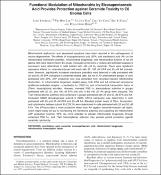
Loading...
Name
attachment.pdf
Size
2.06 MB
Format
Adobe PDF
Checksum
(MD5):642e651b19fa966464e34a83c5657311