Options
Accuracy of Corneal Astigmatism Estimation by Neglecting the Posterior Corneal Surface
Type
article
Resource
American Journal of Ophthalmology 147:788-795
Date Issued
2009
Author(s)
何昭德
Subjects
學科:眼科學科
Abstract
Abstract
PURPOSE: To evaluate the accuracy of corneal astigmatism estimation by neglecting the posterior corneal surface measurement.
DESIGN: Prospective, observational study.
METHODS: The right eyes of 493 subjects were measured with a rotating Scheimpflug camera (Pentacam; Oculus, Wetzlar, Germany). The keratometric corneal astigmatism (KA) was obtained by using the anterior corneal surface measurement and the keratometric index (1.3375) while neglecting the posterior corneal surface measurement. The Pentacam-derived total corneal astigmatism (PA) was derived by doubled-angle vector analysis of the astigmatisms on both corneal surfaces.
RESULTS: The mean arithmetic and absolute estimation errors of the KA magnitude for the PA magnitude were -0.06 +/- 0.28 diopters (D) (range, -0.59 to 0.91 D) and 0.24 +/- 0.16 D (range, 0 to 0.91 D), respectively. The mean arithmetic and absolute estimation errors of the KA angle for the PA angle were -0.6 degrees +/- 12.7 degrees (range, -69.9 degrees to 83.4 degrees) and 7.4 degrees +/- 10.3 degrees (range, 0 degrees to 83.4 degrees), respectively. Among all eyes, 142 eyes (28.8%) had either a KA magnitude that differed by > 0.50 D from the PA magnitude or a KA angle that differed by > 10 degrees from the PA angle. For the 282 eyes with a KA magnitude exceeding 1.0 D (that are candidates for intraoperative correction of a preexisting astigmatism during cataract surgery), 29 eyes (10.3%) had either a KA magnitude that differed by > 0.50 D from the PA magnitude or a KA angle that differed by > 10 degrees from the PA angle.
CONCLUSIONS: Neglecting the posterior corneal surface measurement may lead to significant deviation in the corneal astigmatism estimation in a proportion of eyes.
PURPOSE: To evaluate the accuracy of corneal astigmatism estimation by neglecting the posterior corneal surface measurement.
DESIGN: Prospective, observational study.
METHODS: The right eyes of 493 subjects were measured with a rotating Scheimpflug camera (Pentacam; Oculus, Wetzlar, Germany). The keratometric corneal astigmatism (KA) was obtained by using the anterior corneal surface measurement and the keratometric index (1.3375) while neglecting the posterior corneal surface measurement. The Pentacam-derived total corneal astigmatism (PA) was derived by doubled-angle vector analysis of the astigmatisms on both corneal surfaces.
RESULTS: The mean arithmetic and absolute estimation errors of the KA magnitude for the PA magnitude were -0.06 +/- 0.28 diopters (D) (range, -0.59 to 0.91 D) and 0.24 +/- 0.16 D (range, 0 to 0.91 D), respectively. The mean arithmetic and absolute estimation errors of the KA angle for the PA angle were -0.6 degrees +/- 12.7 degrees (range, -69.9 degrees to 83.4 degrees) and 7.4 degrees +/- 10.3 degrees (range, 0 degrees to 83.4 degrees), respectively. Among all eyes, 142 eyes (28.8%) had either a KA magnitude that differed by > 0.50 D from the PA magnitude or a KA angle that differed by > 10 degrees from the PA angle. For the 282 eyes with a KA magnitude exceeding 1.0 D (that are candidates for intraoperative correction of a preexisting astigmatism during cataract surgery), 29 eyes (10.3%) had either a KA magnitude that differed by > 0.50 D from the PA magnitude or a KA angle that differed by > 10 degrees from the PA angle.
CONCLUSIONS: Neglecting the posterior corneal surface measurement may lead to significant deviation in the corneal astigmatism estimation in a proportion of eyes.
File(s)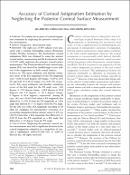
Loading...
Name
attachment.pdf
Size
1.04 MB
Format
Adobe PDF
Checksum
(MD5):e67d580645cb032d6fffbc748f82ad89
Loading...
Name
attachment2.pdf
Size
57.62 KB
Format
Adobe PDF
Checksum
(MD5):7181c382bf2fbd6ba7a966bf43d0f136