Options
Differential effects of spermatogenesis and fertility in mice lacking androgen receptor in individual testis cells
Type
article
Resource
P. Natl. Acad. Sci. U.S.A.(103):18975-18980
Date Issued
2006
Author(s)
葉劭德
Tsai MY*; Yeh SD*; Wang RS*; Yeh S; Zhang C; Lin HY; Tzeng CR; Chang C
Subjects
學科:泌尿學科
期刊論文
Abstract
Using a Cre-Lox conditional knockout strategy, we generated a germ cell-specific androgen receptor (AR) knockout mouse (G-AR(-/y)) with normal spermatogenesis. Sperm count and motility in epididymis from AR(-/y) mice are similar to that of WT (G-AR(+/y)) mice. Furthermore, fertility tests show there was no difference in fertility, and almost 100% of female pups sired by G-AR(-/y) males younger than 15 weeks carried the deleted AR allele, suggesting the efficient AR knockout occurred in germ cells during meiosis. Together, these data provide in vivo evidence showing male mice without AR in germ cells can still have normal spermatogenesis and fertility, suggesting the essential roles of AR during spermatogenesis might come from indirect cell-cell communication in a paracrine fashion. We then compared the consequences of AR loss in the spermatogenesis and fertility of G-AR(-/y) mice with two other testicular cell-specific AR(-/y) mice and total AR knockout male mice. The results provide clear in vivo evidence that androgen/AR signaling in Sertoli cells plays a direct important role in spermatogenesis and in Leydig cells plays an autocrine regulatory role to modulate Leydig cell steroidogenic function. Total AR knockout male mice have the most severe defects among these mice. These contrasting data with G-AR(-/y) mice suggest AR might have different roles in the various cells within testis to contribute to normal spermatogenesis and male fertility in mice.
File(s)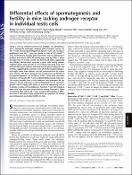
Loading...
Name
attachment.pdf
Size
1.41 MB
Format
Adobe PDF
Checksum
(MD5):c55720feb777cf15cc1b853cbe3b3f51
Loading...
Name
attachment2.pdf
Size
66.61 KB
Format
Adobe PDF
Checksum
(MD5):7cf8aa4c1407bc7da4efc5080b3e5592